The real challenge for organizations struggling to achieve enterprise value from AI is redesigning how work and decisions operate.
- Gartner client? Log in for personalized search results.
The gap between AI ambition and enterprise value
AI investments continue to rise, yet most organizations still concentrate AI value in pilots and task-level automation. Leaders across the organization need to address the structural challenge of aligning the operating model, rather than layering AI onto existing methods of work.
Although 74% of organizations prioritize redesigning structures and jobs alongside AI deployment, many continue to scale AI within existing workflows. This results in an increase in activity without fundamentally improved outcomes.
“AI value is an operating model challenge, not a technology challenge,” confirms Gartner Senior Director Analyst Caroline Hewings.
You might also like this webinar: CHRO’s Role in Leading Enterprise AI Transformation
Shift the focus from AI deployment to operating model design
Closing the gap between AI investment and business value requires leaders to rethink how they prioritize, organize and sustain AI-enabled work. Aligning AI ambition with operating model decisions will shape how value is created and delivered.
Prioritize enterprise value, not automation opportunities
Many organizations begin their AI journey by looking for tasks to automate. While this can generate quick wins, it rarely delivers meaningful enterprise value. Instead, leaders should focus on where redesigning work can improve business outcomes, combining strategic priorities with insight into how work actually happens across the organization. This helps identify the value streams where AI-enabled work redesign will have the greatest impact.
Establish a cross-functional team of business, technology and HR leaders to jointly shape decisions about how work and the workforce evolve.
Focus on the value streams where redesign can create the greatest business impact, rather than simply targeting activities that are easiest to automate.
Prioritize opportunities that combine high business value with a realistic path to implementation, adoption and sustained results.
“Organizations don’t create enterprise value from AI by deploying more tools,” adds Hewings, “they create value by redesigning how work gets done.”
Redesign the system, not isolated parts
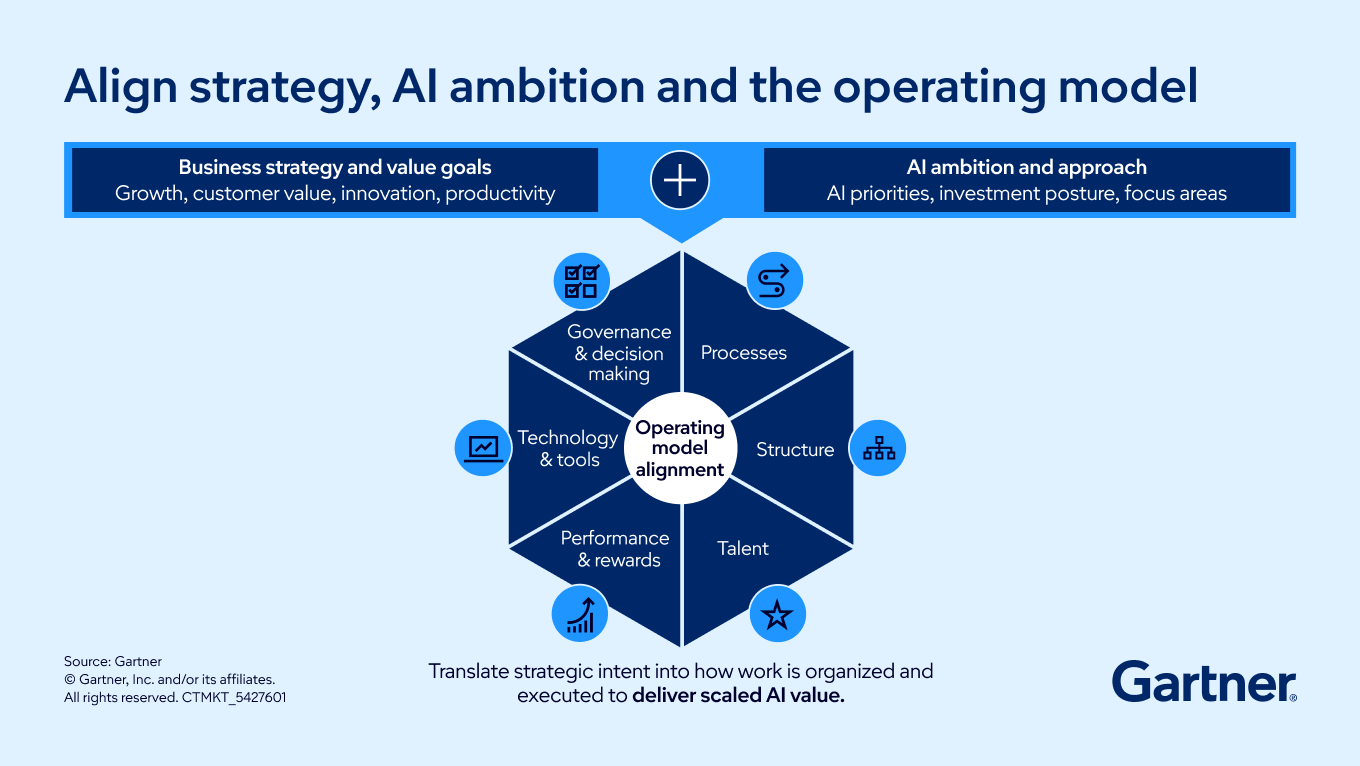
AI reshapes how work flows, how decisions are made and how jobs evolve. Realizing value at scale requires more than optimizing individual tasks. Redesigning the operating model as an interconnected system — aligning workflows, structure, talent, technology and governance — supports new ways of creating value. This requires six key operating model shifts.
Processes: Move from applying AI to tasks to redesigning workflows where AI shapes value creation.
Structure: Shift from siloed functions to cross-functional teams enabled by shared platforms and governance.
Talent: Move from fixed jobs to flexible deployment and evolving contributions.
Performance and rewards: Evolve from measuring activity to reinforcing business and customer outcomes.
Technology: Shift from fragmented tools to shared platforms, reliable data and visibility into work.
Governance: Move from uncoordinated experimentation to aligned prioritization, accountability and ongoing refinement.
Make operating model alignment a continuous evolution
AI transformation is not a one-time initiative. As business priorities, technologies and ways of working evolve, organizations must continually adapt how work is organized and executed to sustain value. Operating model alignment should become an ongoing capability rather than a periodic redesign effort.
Reassess where AI can create the most value based on business priorities, outcomes and emerging capabilities.
Align decisions across the organization to reinforce those priorities.
Continuously review and recalibrate work, talent and incentives as business needs and AI capabilities evolve.
Operating model alignment for AI FAQs
Why is operating model alignment important for AI?
The primary constraint on AI-driven value is structural rather than technological. Enterprise value depends on aligning how work and decisions operate across processes, structure, talent, governance, technology and performance management rather than simply deploying AI tools.
What operating model changes help scale AI value?
Organizations can scale AI value by making six key operating model shifts: redesigning workflows, moving to cross-functional teams, enabling flexible talent deployment, measuring outcomes instead of activity, using shared technology platforms and data capabilities, and strengthening governance through aligned prioritization and accountability.
Why is operating model alignment an ongoing requirement for AI?
AI continuously reshapes work, decisions and value creation. Organizations therefore need ongoing reassessment, alignment and recalibration rather than a one-time transformation effort. Continuous operating model redesign helps ensure AI investments remain aligned with business priorities and outcomes.
Attend a Conference
Join Gartner analysts and your peers to accelerate growth
Gather alongside your peers in Orlando to gain insights on emerging trends, receive one-on-one guidance from a Gartner expert and create a strategy to tackle your priorities head-on.
26 – 28 Oct 2026
Gartner HR Symposium/Xpo™
Orlando, FL

Drive stronger performance on your mission-critical priorities.