Sales operations must evolve now — here’s how to align strategy, talent and tech for AI-driven growth.
- Gartner client? Log in for personalized search results.
Assessing sales operations readiness
Sales operations leaders are being asked to do more than ever before: drive growth, support go-to-market change and keep up with AI-driven transformation. AI and shifting buyer expectations have redefined how sales teams work and what sellers need to be successful. With so many competing priorities, sales operations teams often have little opportunity to step back and evaluate whether their own capabilities are keeping pace. Without intentional evolution, sales ops risks falling behind. As Gartner Senior Director Analyst Wendy Butler-Mafuz notes, “To maintain relevance and prevent technology from outpacing workforce skills, sales operations must adapt how it supports the enterprise.”
You might also like this webinar: Leadership Vision: Sales Operations & Enablement in the AI Era
6 critical elements of sales operations strategic planning
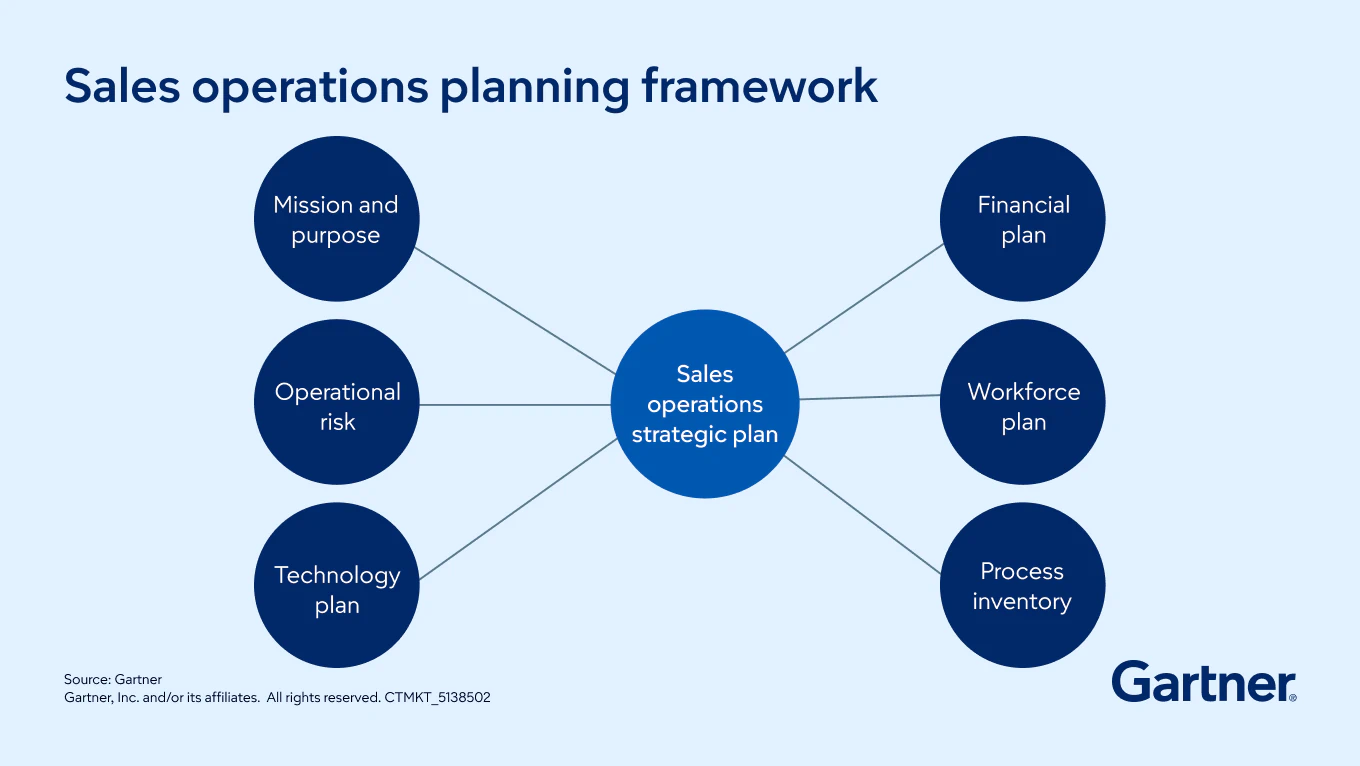
Sales operations leaders should prioritize strategic planning across six critical areas that shape the team’s ability to support the business amid ongoing transformation, rapid AI advancement and shifting buyer expectations.
Establish the sales operations mission and purpose
Start with clarity: Leaders should define the team’s mission and purpose to make sure it aligns with the organization’s priorities. The mission articulates why sales operations exist while purpose dictates what the team is responsible for delivering. Together, they establish a shared understanding of the function’s role, improve cross-functional alignment and provide a framework for decision making. As business priorities evolve, the charter should be reviewed and updated as such. Without this foundation, strategic planning often lacks focus and fails to address the capabilities the business will need in the future.
Establish and manage a financial plan
Financial agility demands a clear view of spending and performance. By tracking key cost and efficiency metrics and scenario planning for both increased investment and budget reductions, sales operations leaders can respond quickly to changing business priorities, while maintaining focus on performance and value creation. This proactive approach enables faster, data-driven decisions, aligns stakeholders around trade-offs and ensures every dollar invested delivers impact.
Build a workforce plan
To keep pace with evolving business demands and advances in AI, sales operations leaders must continuously reassess the skills and capacity of their teams. Success increasingly depends on strengthening strategic leadership, advanced analytics and AI fluency and ensuring the right resources are in place to manage a complex sales technology ecosystem. A targeted workforce plan can help identify skills gaps and ensure the function remains equipped to support future growth.
Inventory and optimize key processes
Before investing in new tools or talent, assess existing processes to uncover inefficiencies, bottlenecks and manual work. A structured process review helps prioritize improvement opportunities, align workflows to stakeholder needs and uncover where AI can automate routine tasks or streamline cross-functional collaboration. By continuously evaluating and optimizing key processes, leaders can increase capacity, improve seller productivity and create a stronger foundation for future technology and workforce investments.
Plan the tech stack
Static technology roadmaps no longer work in today’s fast-moving landscape. Instead, tech stack planning should become a continuous process focused on measuring value, optimizing adoption and ensuring technology aligns with how sellers actually work. An AI-first approach that prioritizes workflow automation and decision support will help organizations maximize technology ROI and adaptability.
Manage operational risks
As organizations navigate constant transformation and rapid AI adoption, managing operational risk has become a critical sales operations responsibility. Leaders must proactively identify, assess and address risks across people, processes, technology and governance. Establish clear oversight, strengthen AI governance and regularly evaluate emerging risks to protect performance while enabling innovation and sustainable growth.
What’s next in sales operations
Building a tech-enabled operating rhythm is one critical step in the CSO’s mandate to reimagine sales productivity in the AI era.
The other steps in this imperative include:
Aligning AI strategy to productivity gaps by fundamentally reimagining workflows around productivity objectives, challenging assumptions and aligning sellers and technology where each has a competitive advantage
Pinpointing productivity and performance levers by breaking down business objectives into actionable productivity outcomes while rigorously challenging model assumptions
Executing AI-driven workflow transformations by evolving operations for activation, acceptance and adoption of AI workflows — preparing data, translating business requirements into AI workflows, establishing governance, validating system efficacy, simplifying seller roles and piloting before scaling
Isolating key metrics and related workflows by decoupling processes from traditional headcount assumptions, identifying which activities drive results, aligning impact metrics to workflows and establishing new baselines with productivity measures independent of FTEs
For more on how Gartner helps drive success on this and other mission-critical priorities for CSOs, speak to us today.
Sales operations FAQs
What areas should be evaluated during a sales operations assessment?
Leaders should evaluate mission and purpose, financial planning, workforce capabilities, business processes, technology investments and operational risk management.
How does AI impact sales operations priorities?
AI can automate routine activities, improve decision making, enhance forecasting and increase seller productivity. Realizing these benefits requires the right skills, processes and governance.
What skills will be most important for future sales operations teams?
Strategic leadership, advanced analytics, AI fluency, change management, process optimization and technology management are becoming increasingly critical.
How often should sales operations leaders revisit their operating model?
Organizations should review their operating model annually at a minimum, with more frequent reviews during periods of significant business, organizational or technology change.
Attend a Conference
Join Gartner analysts and your peers to accelerate growth
Gather alongside your peers in Las Vegas to gain insight on emerging trends, receive one-on-one guidance from a Gartner analyst and create a strategy to tackle your priorities head-on.
18 – 19 May 2027
Gartner CSO & Sales Leader Conference
Las Vegas, NV

Drive stronger performance on your mission-critical priorities.