Unlocking AI’s potential in sales demands more than efficiency gains — CSOs must actively orchestrate capacity to drive real growth.
- Gartner client? Log in for personalized search results.
AI time savings expose the automatic capacity expansion fallacy
AI promises to streamline sales processes, but time savings alone rarely translate into revenue growth. Many sales leaders fall for the “automatic capacity expansion fallacy” — assuming that freed-up time will automatically boost productivity and commercial results. In reality, without intentional intervention, sales teams may simply do the wrong things faster, amplifying inefficiencies and poor decision making. This risk is especially acute as organizations rush to implement AI tools without redesigning their sales systems. What happens? Revenue stalls, and the hoped-for gains never materialize.
You might also like this webinar: Redefine CSO Excellence: The Power Skills Needed for Revenue Growth
AI time savings require capacity orchestration to unlock value
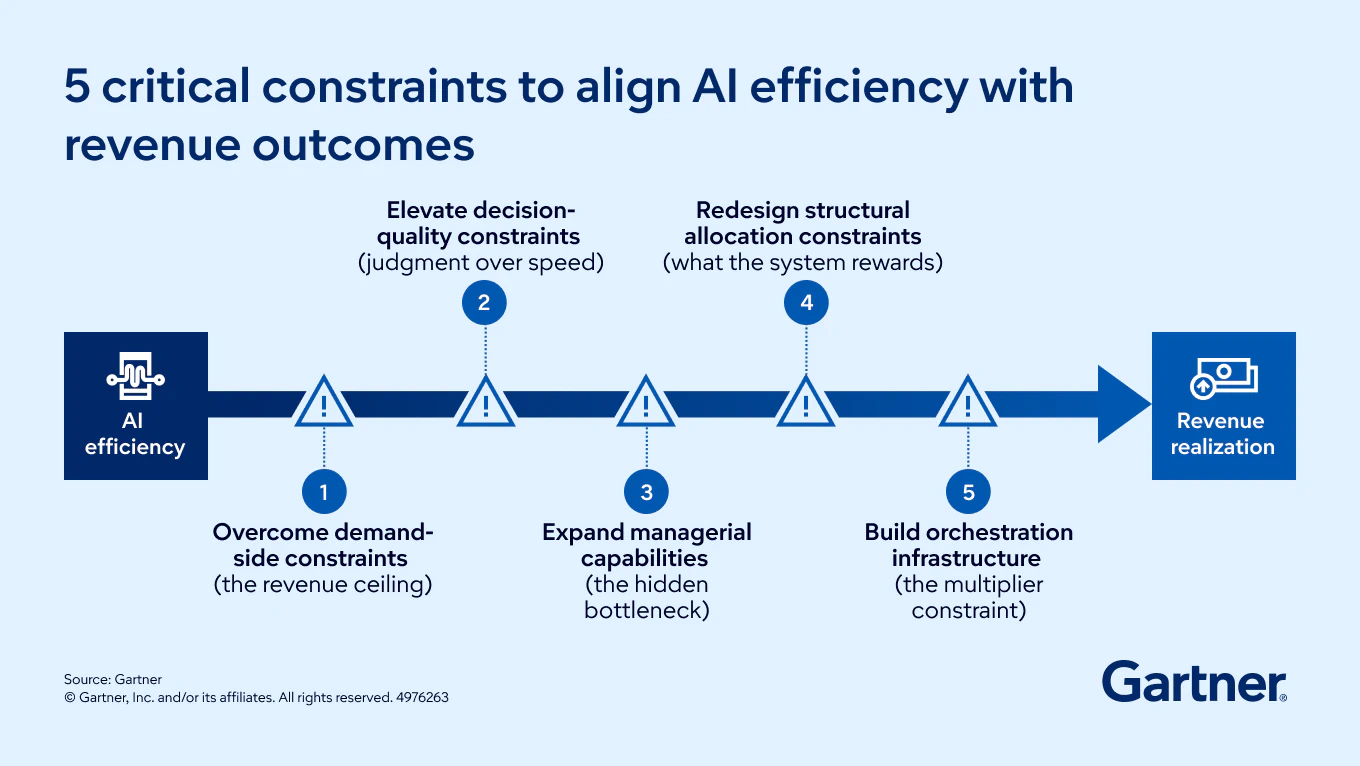
AI-driven efficiency only pays off when CSOs actively manage how sales teams use their new capacity. There are five critical constraints that must be addressed:
1. Demand-side limits sabotage AI time savings
You can’t sell more if buyers aren’t ready. AI may streamline outreach, but demand-side constraints — like market saturation or buyer hesitancy — can strangle sales growth. Even with increased capacity, sales teams hit a wall if customer demand doesn’t keep pace. CSOs must assess real market opportunities before reallocating AI-generated time.
2. Decision quality determines revenue outcomes
AI can accelerate decision making, but speed without quality is dangerous. Data reveals that poor decisions — like chasing low-value leads or misaligning priorities — waste capacity and undermine growth. CSOs need to invest in frameworks that boost decision quality, ensuring time savings are spent on high-impact activities.
3. Managerial capabilities drive productive use of AI time savings
Managers are the linchpin. Without strong coaching and oversight, sales reps may revert to old habits or misuse their newfound time. Organizations with robust managerial capabilities convert AI efficiency into measurable revenue gains. CSOs should prioritize manager training and accountability.
4. Structural allocation rewards the right behaviors
Incentives matter. If compensation plans and KPIs reward quantity over quality, AI time savings will fuel the wrong behaviors. Analysts recommend redesigning incentives to align with strategic goals — rewarding reps for outcomes that drive sustainable growth, not just activity volume.
5. Orchestration infrastructure enables scalable impact
Systems and processes must support capacity orchestration. There is a clear need for integrated tools, comprehensive workflows and transparent measurement. CSOs should ensure their infrastructure can track, manage and optimize how AI-generated time is deployed across the sales organization.
Turn AI time savings into revenue: CSO action steps
CSOs need to lead the charge. Start by mapping current sales bottlenecks, then redesign incentives and decision frameworks to channel AI-generated capacity toward high-value opportunities. Invest in manager development and build orchestration infrastructure that supports scalable impact. Measure outcomes relentlessly — don’t just assume time savings equal revenue.
Build a capacity orchestration roadmap
Identify which constraints are most acute in your organization. Use Gartner insights to benchmark against peers, then create a phased plan to address demand limits, decision quality, managerial gaps, structural misalignments and infrastructure needs.
What’s next in sales revenue growth
Aligning AI strategy to productivity gaps is one critical step in the CSO’s mandate to reimagine sales productivity in the AI era.
The other steps in this imperative include:
Building a tech-enabled operating rhythm by embedding calculation, monitoring and validation of productivity into AI-driven systems and the supporting operations layer, using technology to streamline workflows, reduce decision fatigue and sustain high‑value performance gains.
Executing AI-driven workflow transformations by evolving operations for activation, acceptance and adoption of AI workflows — preparing data, translating business requirements into AI workflows, establishing governance, validating system efficacy, simplifying seller roles and piloting before scaling.
Isolating key metrics and related workflows by decoupling processes from traditional headcount assumptions, identifying which activities drive results, aligning impact metrics to workflows and establishing new baselines with productivity measures independent of FTE.
Pinpointing productivity and performance levers by breaking down business objectives into actionable outcomes while rigorously challenging model assumptions.
AI time savings FAQs
How can CSOs ensure AI time savings drive revenue growth?
CSOs must orchestrate capacity by redesigning sales systems, incentives and management practices. Revenue gains only occur when leaders actively channel AI-generated time toward high-impact activities, address demand-side limits and improve decision quality.
What are the biggest risks of unmanaged AI time savings?
Unmanaged AI time savings can amplify inefficiencies, poor decisions and misaligned behaviors. Without orchestration, sales teams may focus on low-value tasks, leading to stalled revenue and wasted capacity.
Which sales constraints most commonly sabotage AI time savings?
There are five key constraints: demand-side limits, decision quality, managerial capabilities, structural allocation and orchestration infrastructure. Addressing these is essential for converting AI efficiency into commercial advantage.
Attend a Conference
Join Gartner analysts and your peers to accelerate growth
Gather alongside your peers in Las Vegas to gain insight on emerging trends, receive one-on-one guidance from a Gartner analyst and create a strategy to tackle your priorities head-on.
18 – 19 May 2027
Gartner CSO & Sales Leader Conference
Las Vegas, NV

Drive stronger performance on your mission-critical priorities.