Seller productivity improves when roles evolve alongside technology.
- Gartner client? Log in for personalized search results.
Why AI alone is not solving the productivity problem
Sales organizations continue investing heavily in AI while boards and executive teams expect measurable productivity improvements. Yet many leaders struggle to demonstrate meaningful gains from those investments.
Many organizations are applying new technology to sales roles that remain fundamentally unchanged. Sellers continue carrying the same responsibilities, managing the same workflows and operating under the same expectations they did before AI entered the sales process. As a result, AI often becomes another technology tool sellers must manage rather than a catalyst for productivity gains.
You might also like this webinar: Outsmart Disruption: Using AI to Build Unbreakable Sales Organizations
The problem is seller role design
Most sales roles were designed when human sellers performed nearly every sales activity themselves. They researched accounts, gathered information, managed administrative work, coordinated internal resources and engaged directly with customers throughout the sales process.
Those assumptions no longer hold.
As AI assumes a growing share of research, administrative and analytical activities, the role of the seller changes as well.
“Productivity gains and measurable ROI will continue to disappoint until CSOs stop layering AI on top of other seller responsibilities and begin evaluating how seller roles are changing as AI utilization increases,” says Greg Hessong, Senior Director Analyst at Gartner.
Focus sellers on what humans do best
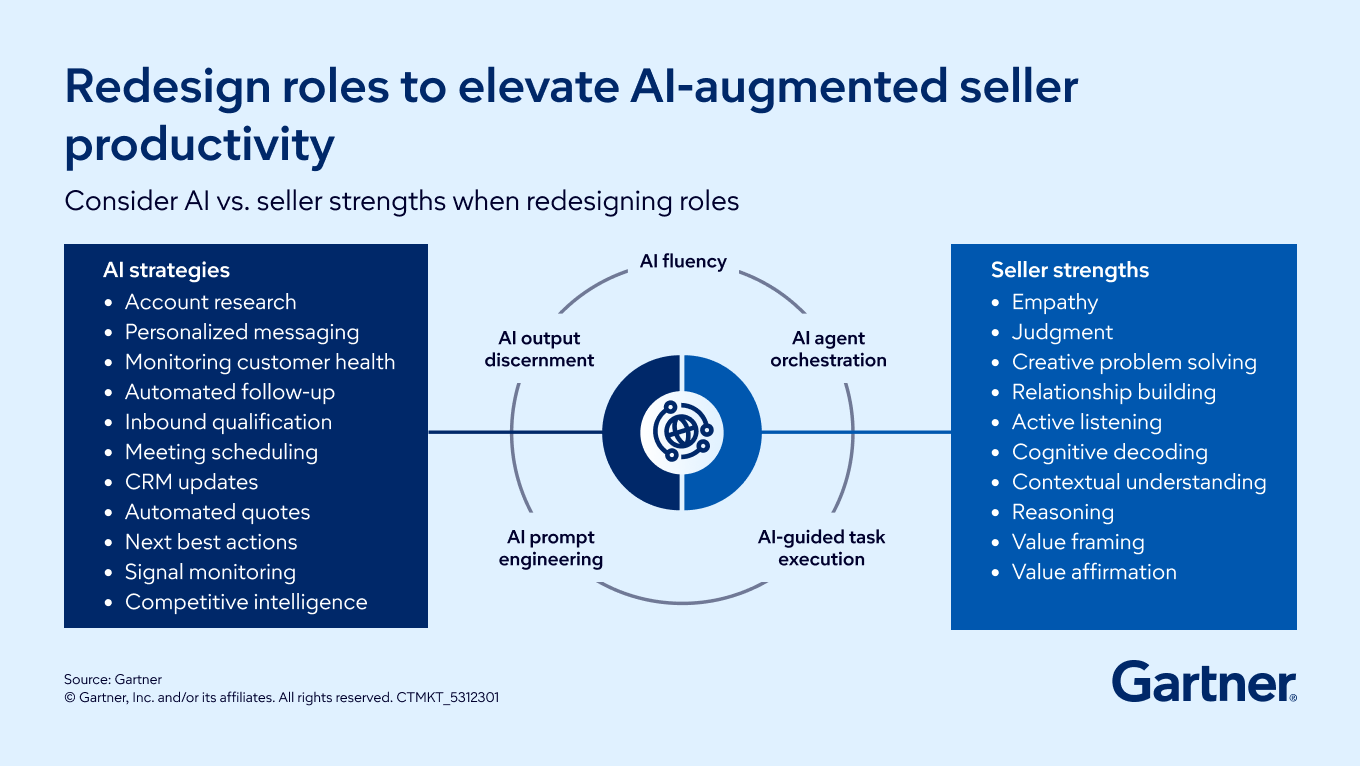
As AI handles a larger share of routine activities, uniquely human capabilities become more valuable.
Judgment, empathy, negotiation, consensus building and complex problem solving remain critical in selling environments where customers face difficult decisions, competing priorities and organizational complexity.
Seller productivity improves when sellers spend less time on administrative work and more time on the activities that require human insight, trust-building and commercial judgment.
Prepare sellers for AI-enabled work
Role redesign requires more than introducing new technology. It requires preparing sellers for new responsibilities.
As AI becomes embedded in sales workflows, CSOs must decide where AI creates the greatest value, how work should be distributed and what capabilities sellers need to succeed in an AI-enabled environment.
Leaders should:
- Identify where AI should be deployed by examining sales activities that can be automated or supported through AI-enabled workflows.
- Upskill sellers to work effectively with AI by helping them evaluate outputs, oversee workflow quality and determine when human intervention is required.
- Redesign roles around emerging responsibilities so sellers spend more time building consensus, delivering insight and navigating complex customer decisions.
“Success requires moving beyond simply having AI take ownership of some tasks while sellers do the rest. Sellers also need to learn how AI helps them to be more effective and valuable to the customers they support,” says Hessong.
Organizations that redesign seller roles alongside AI deployment are more likely to realize meaningful productivity gains.
Build sales roles that evolve with AI
AI capabilities will continue to evolve, which means seller roles must evolve as well.
The sales organizations that realize the greatest long-term value will continuously evaluate which activities should remain with human sellers, which should be delegated to AI and how roles should adapt as technology matures.
Leaders should identify opportunities for AI-enabled workflows, learn from experimentation occurring elsewhere in the organization and remain willing to adjust role definitions as conditions change.
Future-fit sales organizations treat role design as an ongoing discipline rather than a periodic transformation initiative.
Sales productivity FAQs
Why aren’t AI investments improving seller productivity?
Many organizations deploy AI without changing how sales work is organized. Sellers often remain responsible for the same activities, workflows and expectations they managed before AI adoption, limiting the productivity gains organizations expect.
Why do sales roles need to change in the AI era?
Most sales roles were designed when human sellers performed nearly every sales activity themselves. As AI takes on more research, administrative and analytical work, sales leaders need to redesign roles around the activities where human judgment, relationship-building and problem-solving create the greatest value.
How can CSOs prepare sellers for AI-enabled work?
CSOs should identify where AI can be embedded into sales workflows, help sellers develop skills for overseeing AI-enabled processes and redesign roles around emerging responsibilities. Preparing sellers for AI-enabled work requires changes to role design as well as technology adoption.
Attend a Conference
Join Gartner analysts and your peers to accelerate growth
Gather alongside your peers in Las Vegas to gain insight on emerging trends, receive one-on-one guidance from a Gartner analyst and create a strategy to tackle your priorities head-on.
18 – 19 May 2027
Gartner CSO & Sales Leader Conference
Las Vegas, NV

Drive stronger performance on your mission-critical priorities.