Give employees confidence in how their value and contributions evolve alongside AI.
- Gartner client? Log in for personalized search results.
AI adoption is creating a workforce identity crisis
For many employees, work shapes part of their identity and who they are as human beings. As AI becomes increasingly capable, employees are questioning not only how their work will change, but also how it will affect their sense of identity, purpose and professional value.
According to Pew Research Center data, 32% of workers believe AI will lead to fewer job opportunities in the long run.
“AI transformations are triggering a workplace identity crisis that traditional change management approaches are structurally unequipped to resolve,” says Lydia Wu, Senior Director Analyst at Gartner.
As uncertainty grows, resistance to change, lower AI adoption and disappointing ROI often follow. CHROs can address this challenge by shaping work so employees can create value alongside AI rather than compete with it.
You might also like this webinar: Develop a Skills Strategy That Accelerates Organizational Performance
Defining the unique role of people in the age of AI
AI can execute tasks, but people remain responsible for purpose, judgment, context and accountability. Organizations that help employees understand this distinction can improve adoption and realize greater value from AI investments.
Purpose and accountability still belong to people
A common misconception is that AI and human knowledge exist on the same continuum. In practice, they occupy fundamentally different roles. AI generates responses using available, machine readable information, while people originate knowledge, shape intent, set desired outcomes and remain accountable for decisions.
All work contains two components:
Purpose: Why the work is done
Task execution: How the work tasks are performed
AI may increasingly perform task execution, but people remain essential for establishing purpose, guiding outcomes and ensuring accountability.
Human judgment remains critical as well. AI can generate responses, but employees decide whether those responses should be trusted, applied or challenged based on business context, relationships and organizational priorities.
Focus support where employees need it most
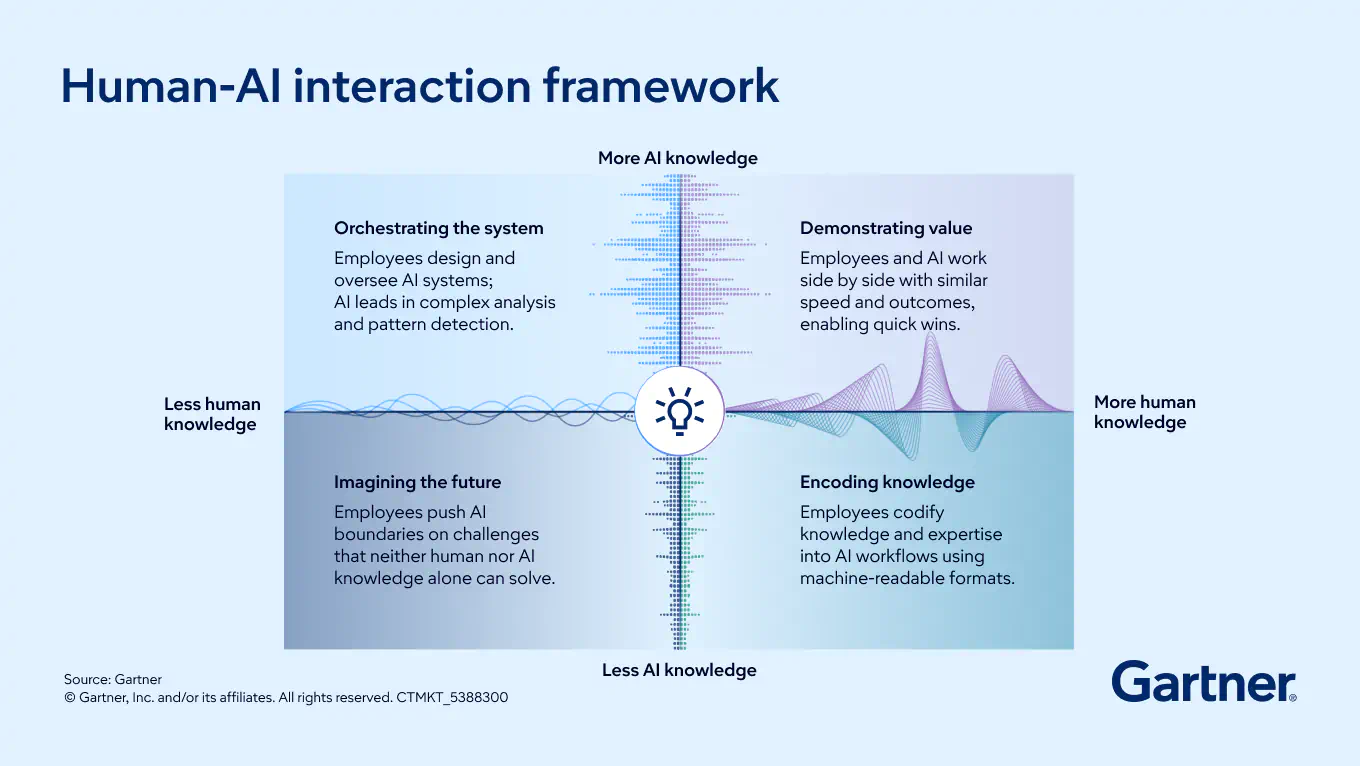
Different AI use cases create different employee experiences. The Gartner Human-AI Interaction Framework helps CHROs understand where uncertainty, resistance and adoption challenges are most likely to emerge.
The framework highlights four common interaction patterns:
Orchestrating the system: Employees design and supervise AI-driven work and determine when to rely on machine outputs versus human judgment. Systematic thinking and scientific design skillsets are critical here.
Demonstrating value: When AI begins performing work that employees have traditionally owned, concerns about job security and future relevance often increase. Proactively communicate the anticipated role of AI and discuss how responsibilities will evolve.
Encoding knowledge: Employees are asked to transfer expertise into AI-enabled workflows. Psychological safety becomes critical because employees may fear that sharing knowledge reduces their future value to the organization.
Imagining the future: Employees experiment with entirely new AI-enabled ways of working. These environments require trust, experimentation and a willingness to learn from failure.
Each scenario creates different concerns and requires different leadership interventions.
Create confidence in an AI-enabled future
Employees are more likely to embrace AI when they can clearly see a future for themselves within the transformation.
According to Gartner, CHROs should:
Clearly articulate the anticipated future role of people and AI in the organization.
Be specific about role-level impacts when jobs are likely to change.
Address psychological safety concerns directly.
Present a future vision for employee development and growth.
Create environments where employees are comfortable experimenting with AI and sharing knowledge.
When employees understand their role in an AI-enabled workplace, they are more likely to engage with change and contribute to successful AI outcomes.
AI adoption FAQs
Why do employees resist AI adoption?
Employees often resist AI because they fear becoming irrelevant. Gartner insights indicate that AI adoption challenges frequently stem from concerns about identity, purpose and future opportunities rather than a lack of technical skills.
Are employees competing with AI?
No. According to Gartner, employees are not in direct competition with AI. While AI can perform many tasks, people remain responsible for defining purpose, exercising judgment, understanding context and maintaining accountability.
How can CHROs improve AI adoption?
CHROs should help employees understand how their roles evolve alongside AI. Gartner recommends providing role clarity, addressing fears of irrelevance, strengthening psychological safety and helping employees understand how they create value within AI-enabled workflows.
Attend a Conference
Join Gartner analysts and your peers to accelerate growth
Gather alongside your peers in Orlando to gain insights on emerging trends, receive one-on-one guidance from a Gartner expert and create a strategy to tackle your priorities head-on.
26 – 28 Oct 2026
Gartner HR Symposium/Xpo™
Orlando, FL

Drive stronger performance on your mission-critical priorities.