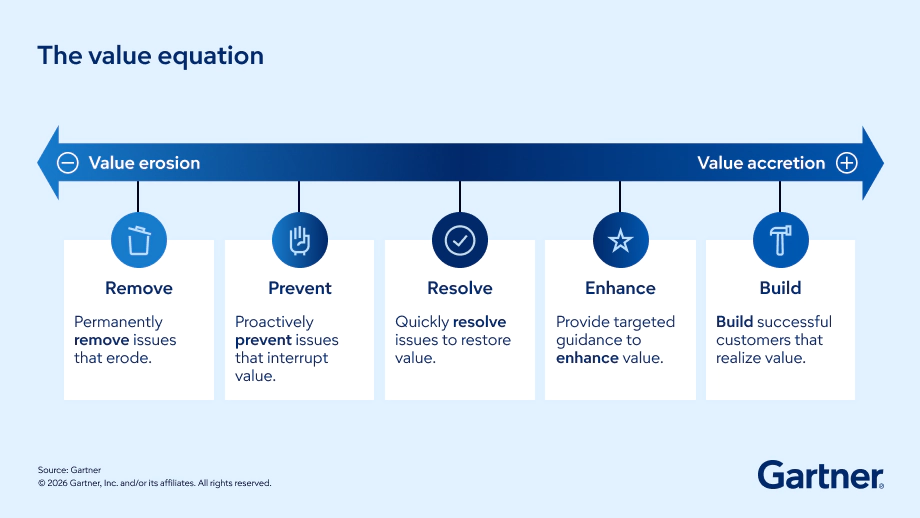
The most progressive service and support organizations are evolving from problem solvers to value creators by helping customers not only resolve issues, but achieve outcomes. This is the key to turning service and support into a true growth engine.

When customers realize clear, repeatable benefits, they adopt, renew, expand and advocate — generating predictable demand for your products and services, while lowering retention and acquisition costs for your organization. 

Leading organizations understand that centering on value is not just about delivering value to customers. It’s equally about removing the experiences that drain and erode value. Service and support organizations must master both sides of this equation.

Value-centered service (VCS) is a strategic model and operating architecture that defines how service and support can transform to realize its potential as a corporate growth engine. The model comprises five pillars: remove, prevent, resolve, enhance and build. 
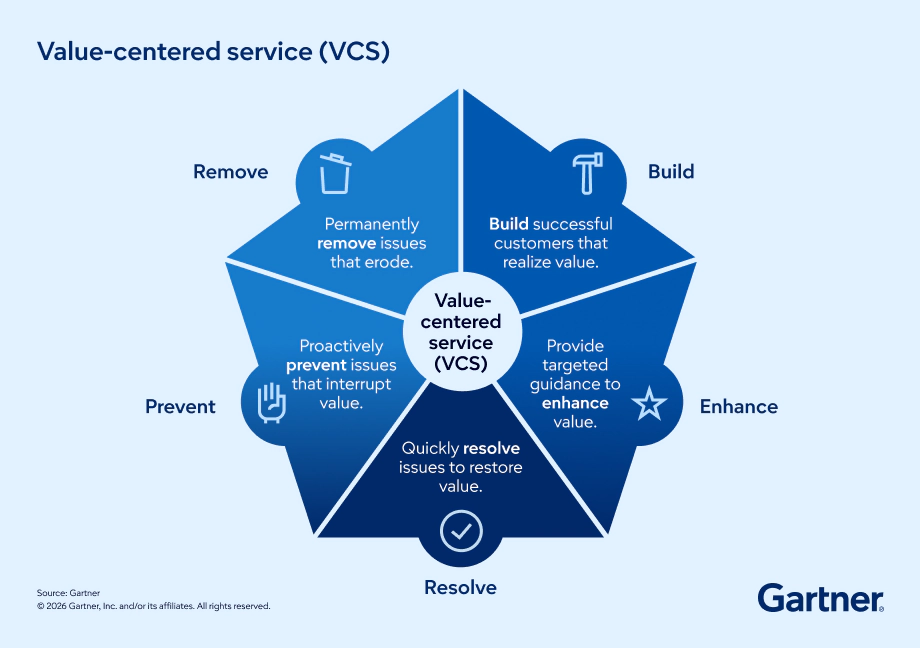
The five pillars of the VCS model provide the practices, processes and metrics that service leaders can use to maximize long-term customer and business value by prioritizing strategies that:

  • Remove product, policy, process and procedure issues that erode value

  • Prevent issues proactively that can interrupt value

  • Resolve issues quickly and thoroughly to restore a customer's path to value 

  • Enhance value through service and support interactions using targeted advice and guidance

  • Build successful customers by proactively enabling and guiding them throughout their life cycle with the goal of ensuring value realization at every point

When service becomes the engine that delivers value, it shifts from simply resolving issues to unlocking and protecting revenue, driving sustainable growth and strengthening customer success.

Establish a value-centered service model

The VCS model prioritizes customer value and outcomes with a fundamental shift from reactive, random or disconnected activities to proactive, deliberate and scalable customer engagement.

Outcomes are defined as measurable changes customers experience from using your product and services. Value is defined as customers’ perception of those changes and the net benefit they receive. The focus of VCS is both: Outcomes are the evidence and value is the judgment. This focus ultimately drives financial and reputational benefits for the organization.

While traditional service focuses only on identifying the cause, triaging and resolving the single issue, a VCS model views interactions not as an opportunity to close a ticket or case, but as a chance to advance the customer toward their desired outcome. This contextual reframing is reflected across each of the five VCS pillars.

These pillars each address a specific aspect of the value equation that ultimately influences the customer’s decision to: 

  • Stay or leave

  • Escalate or tolerate

  • Switch or substitute

  • Buy more or downsize

  • Advocate or detract

Those decisions define customer lifetime value and directly impact your organization’s ability to retain and expand existing customers, along with net new customer acquisition.

Remove

The Remove pillar focuses on permanently removing value-eroding interactions. These value-eroding interactions — often caused by poor product quality, defects, outdated policies or unclear instructions — detract from a customer achieving outcomes and realizing value. 

By systematically addressing and eliminating value-eroding contacts (estimated to be between 21% and 60% of total demand), service leaders wield the single biggest economic lever to eliminate cost and create the operational capacity necessary to focus on other VCS pillars.

To operationalize this pillar, leaders should follow the four-step PIRG methodology (plan, investigate, remediate, guide), which focuses on quantifying demand, conducting root-cause analysis (RCA) to trace issues outside the service organization, and implementing cross-functional remediation plans to ensure avoidable interactions are nonexistent.

Prevent

Preventing issues from reaching the customer protects and preserves value, reduces churn risk and shifts resources from reactive firefighting to proactive value creation. Early detection lowers customer effort and frustration by preempting issues before they become disruptions.

The cumulative effect of preventing issues from occurring can be measured in fewer reactive service calls, faster time to value for customers, improved customer retention and reclaimed resource capacity that can be redeployed on value-building activities. 

Operationalizing proactive prevention requires instrumentation and telemetry monitoring of customer product and service use, along with customer journey progress to detect anomalies and potential issues. Real-time monitoring and the use of predictive alerts allow corrective action with lower remediation cost. Issue prevention follows a simple formula: signals, detection, intervention, outcome.

Resolve

In VCS, resolution is viewed through the lens of the customer relationship and their individual goals, rather than as a one-off transactional event. Every customer engagement must be anchored on outcomes, not activities. This begins by shifting conversations from “We resolved your issues” to “We advanced your goal.”

This approach delivers tangible benefits: It protects and enhances trust, reduces operational workload and lowers costs. When customers know their concerns will be resolved swiftly and thoughtfully, their confidence in your business grows. Trust flourishes, and your team is empowered to deliver service that truly matters.

All service and support organizations have operationalized resolution, so they should instead standardize core restoration practices across both self- and assisted-service solutions. This requires an alignment of processes, tools, knowledge and culture with customer outcomes.

Enhance

Enhancing value in an interaction begins with intentionally transforming customer exchanges from transactional touchpoints into moments that advance their desired business outcomes or personal goals. 

For the organization, value-enhanced interactions drive customer product and service adoption, resulting in higher retention, increased expansion and stronger advocacy. Customers who realize outcomes are more likely to renew, buy more and refer others. These interactions also lower cost-to-serve over time by preventing repeat incidents and reducing escalations.

To operationalize this pillar, leaders must create standardized questions and runbooks that surface customer outcome and value gaps, mapping common value-restoration and product and service adoption remedies to these gaps. Outcome and value gaps can be surfaced through technology and agent questioning, with agents using system-provided next-best actions that enhance the customer conversation.

Build

Building successful customers means customers achieve the specific outcomes for which they purchased the product or service.

Organizations that systematically build successful customers see higher retention, lower churn-driven revenue loss, deeper product and service adoption, stronger growth and more referrals. With existing customers accounting for an estimated 65% of total revenue, organizations must close the gap between their own value proposition and customer outcomes.

To operationalize this pillar, design a value exchange that details the required steps and activities necessary to guide, monitor and measure the customer’s journey toward successful outcomes across the entire life cycle.

Ready for what’s next? We can help.

Access objective insights, exclusive peer networks and expert guidance designed for leaders like you.