Based on insights from hundreds of CHROs, discover actionable frameworks and research-backed guidance to navigate AI transformation, workforce redesign, and C-suite strategy in 2027.
- Gartner client? Log in for personalized search results.
HR Trends 2027: Top Priorities for CHROs and HR Leaders
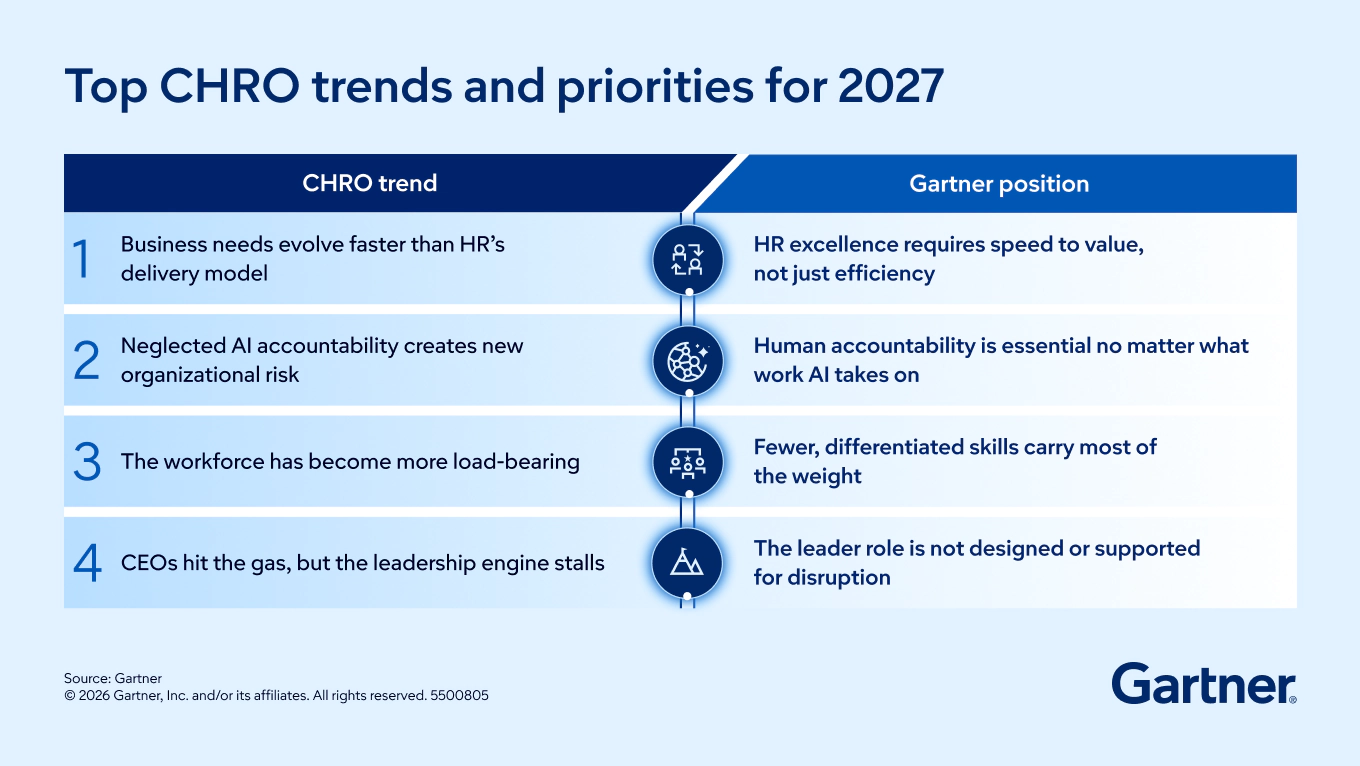
What are the HR trends and CHRO priorities in 2027?
The HR trends and CHRO priorities for 2027 center on four focus areas: accelerating HR’s speed to value, reinforcing human accountability for AI, investing in differentiated workforce skills and preparing leaders to drive disruption.
Based on insights from hundreds of CHROs and senior business executives, Gartner identifies the priorities most critical to strengthening HR strategy and driving enterprise performance.
Use these insights to:
- Identify the four priorities shaping the 2027 CHRO agenda
- Understand the forces changing HR, workforce and leadership strategy
- Take action to strengthen workforce and enterprise performance
Key CHRO Takeaways for 2027
Redesign HR delivery around speed to value, not process efficiency alone.
Establish clear human accountability for decisions and outcomes involving AI.
Focus workforce investments on the differentiated skills that create the most enterprise value.
Equip leaders to challenge entrenched ways of working and drive disruption.
Align HR strategy with business demands for growth, productivity and faster AI returns.
HR trends and priorities FAQs
These FAQs address the most common questions CHROs have about the HR trends and strategic priorities shaping 2027.
What are the top HR trends and CHRO priorities for 2027?
The top four trends shaping CHRO priorities for 2027 reflect an opportunity to define or redefine strategic priorities, make more intentional trade-offs, build differentiated capabilities and increase HR’s influence on business outcomes:
Business needs are evolving faster than HR's delivery model: As business needs grow broader and more complex, CHROs should focus on accelerating HR's speed to value by applying product principles to enable HR to deliver greater impact, faster.
Neglected AI accountability creates new organizational risk: As AI distributes decisions across people and systems, CHROs should focus on mitigating organizational risks by establishing human accountability, no matter what work AI takes on.
The workforce has become more load-bearing: As organizations rely on smaller shares of employees to sustain business performance, CHROs should focus their skill investments toward differentiated skills capabilities that drive value.
CEOs are hitting the gas, but the leadership engine is stalling: As CEOs pursue transformation at unprecedented speed, CHROs must prepare leaders to be able to take calculated risks by redesigning the leader role and making disruption part of the job.
On‑Demand Webinar: Top CHRO Priorities for 2027
How can CHROs help business leaders manage change and disruption effectively?
CHROs can help business leaders manage change and disruption by making it an explicit and accountable part of the leader role. This includes aligning expectations, goals and support so leaders can challenge established ways of working and build change capabilities within their teams.
When change becomes part of everyday work rather than a periodic initiative, organizations are three times more likely to achieve healthy change adoption.
How are CHROs evolving HR operating models to integrate AI agents?
CHROs are moving beyond structural reorganization to redesign how HR works, integrating AI agents as strategic partners within new AI-enabled HR operating models. Success requires clear governance, targeted upskilling, disciplined pilots, close HR-IT collaboration and a continuous innovation mindset focused on business outcomes.
How did Gartner identify the 2027 HR trends and CHRO priorities?
Gartner drew on insights from CHROs, CEOs, senior business executives, HR leaders and employees across industries and geographies. These perspectives were supplemented by an analysis of millions of U.S. job postings, market analysis and subject matter expertise to identify the trends shaping HR strategy and enterprise performance in 2027.