Practical strategies for CHROs to rebuild workforce trust amid disruption
- Gartner client? Log in for personalized search results.
Redefining the Employee Value Proposition (EVP)
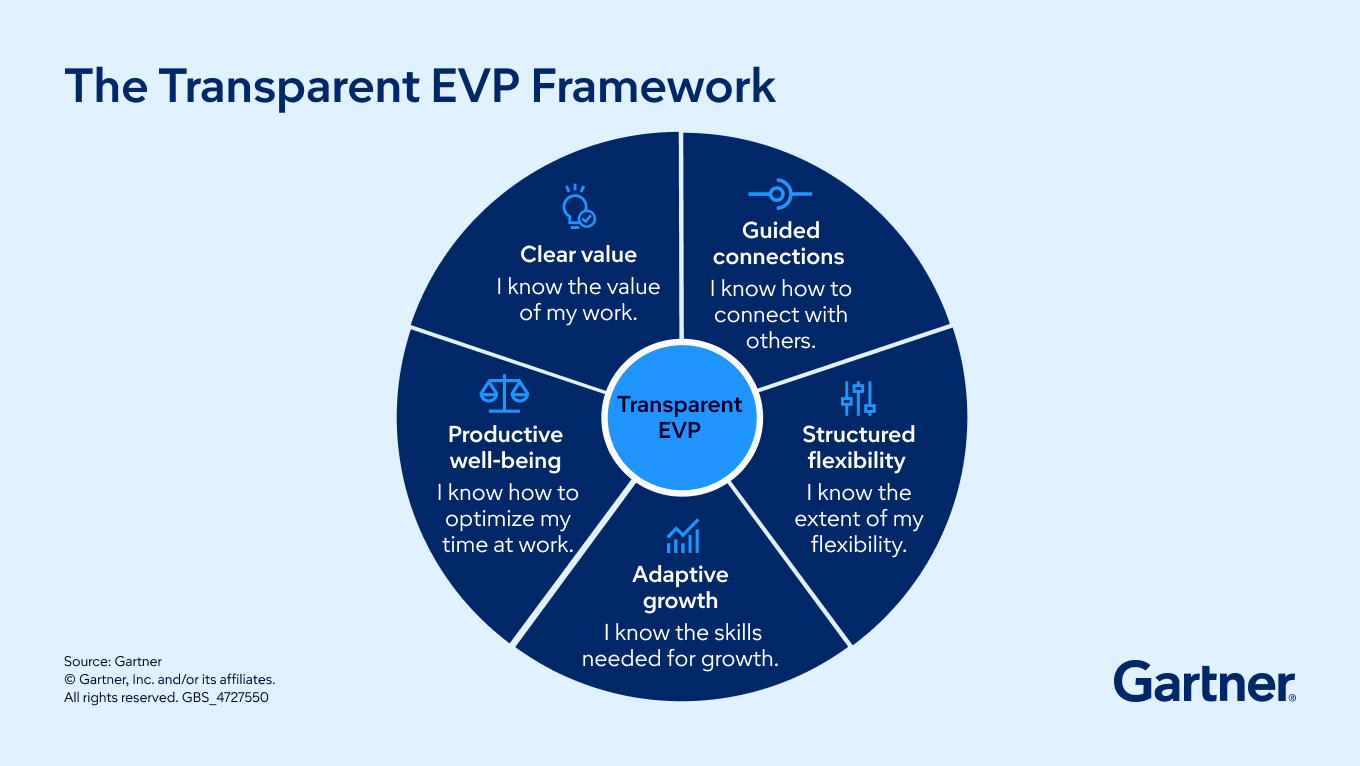
How Transparency Elevates Your EVP
CHROs are navigating constant disruption and shifting workforce expectations. Most employees face uncertainty, heavier workloads, and reduced flexibility—yet fewer than half trust their organization’s promises. In this environment, transparency in EVP design and communication is essential. Gartner research shows employees who perceive transparent decision-making are 4.3 times more likely to trust senior leaders.
Download Gartner’s EVP guide for CHROs to:
- Redesign the EVP to set clear limits and expectations to protect trust
- Define what employees can and cannot expect across five EVP domains
- Align flexibility with roles and business needs
- Clarify well-being, growth, pay, and purpose to sustain engagement
Attend a Conference
Join Gartner analysts and your peers to accelerate growth
Gather alongside your peers in Orlando to gain insights on emerging trends, receive one-on-one guidance from a Gartner expert and create a strategy to tackle your priorities head-on.
26 – 28 Oct 2026
Gartner HR Symposium/Xpo™
Orlando, FL

FAQ on employee value proposition
What is an employee value proposition (EVP)?
The employee value proposition is the set of attributes that the labor market and employees perceive as the value they gain through employment with the organization.
What are the key components of a strong EVP?
A strong EVP comprises a combination of benefits, rewards and experiences that an organization offers to attract, engage and retain talent. Key components include competitive compensation, comprehensive benefits, growth opportunities, a positive work culture, work-life balance, alignment with company values and a clear career path. Communication of the EVP is also crucial to showcase the organization’s unique value and differentiate it from competitors.
How can I measure the effectiveness of an EVP?
To measure EVP effectiveness, use quantitative metrics like:
Retention rates
Engagement surveys
Productivity metrics
Qualitative measures include:
Employee feedback
Employer brand perception
Recruitment metrics (such as qualified applicants and time-to-fill)
Regularly analyze these metrics for insights into EVP impact on attracting, engaging and retaining talent.