Based on insights from hundreds of CHROs, explore the key HR trends and priorities shaping strategy, performance, and leadership decisions in 2026.
- Gartner client? Log in for personalized search results.
2026 HR Trends: 4 Strategic Priorities for the Modern CHRO
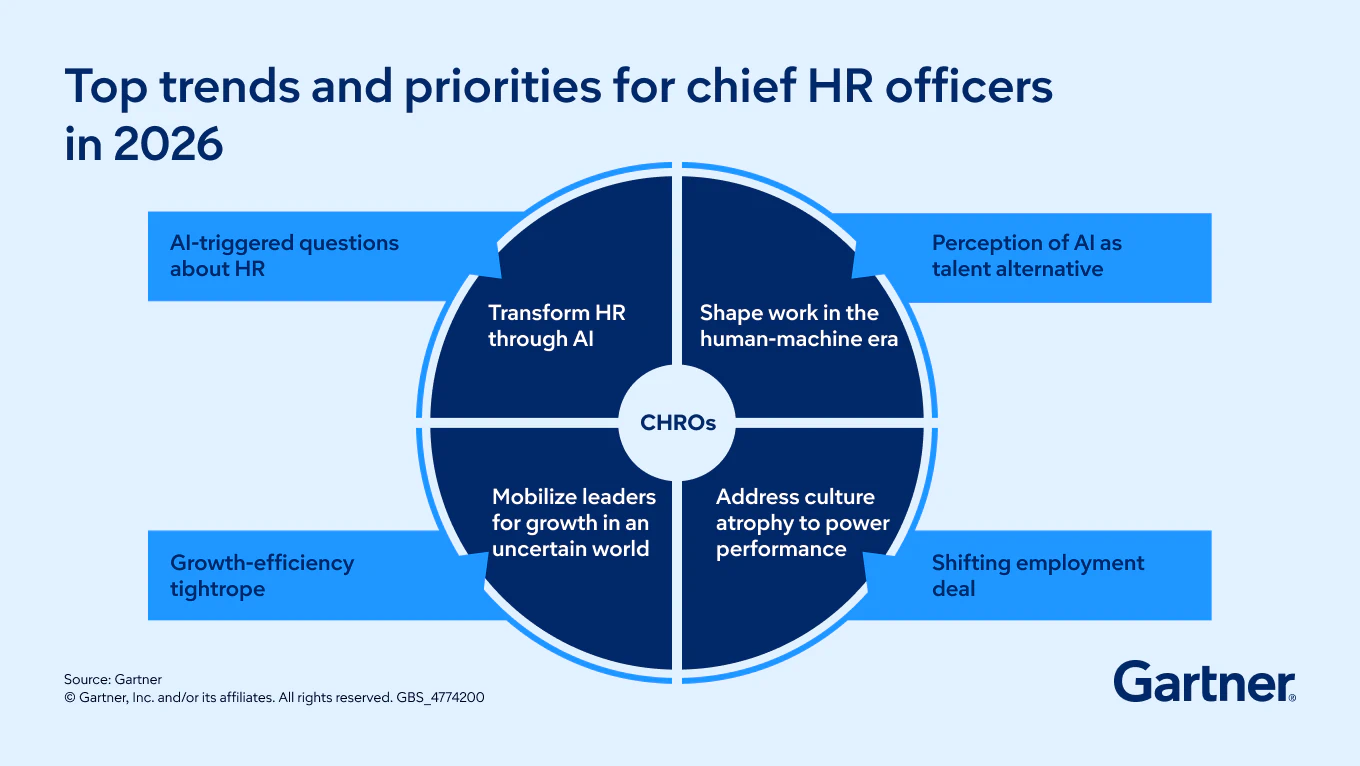
What are the HR trends and CHRO priorities in 2026?
The HR trends and CHRO priorities for 2026 center on four focus areas: AI‑driven HR transformation, workforce redesign in the human‑machine era, leadership readiness amid uncertainty, and embedding organizational culture to drive performance. Gartner’s research, based on hundreds of CHROs across industries, highlights how these priorities are shaping HR strategy and business impact.
This research helps CHROs:
- Identify the four initiatives CHROs are prioritizing in 2026
- Understand the forces driving HR strategy shifts
- Apply actionable next steps to guide enterprise decisions
HR trends and priorities FAQs
These FAQs address the most common questions CHROs have about the HR trends and strategic priorities shaping 2026.
What HR trends are CHROs prioritizing on in 2026?
Based on insights from 426 CHROs across 23 industries and 4 global regions, Gartner identified four top priorities for CHROs in 2026:
Harness AI to Revolutionize HR: CHROs must craft a clearly defined, HR-focused AI strategy. A critical aspect of this is evolving the HR operating model, which has the highest predicted impact on AI productivity gains at 29%.
Shape Work in the Human-Machine Era: The priority is to develop a "now-next" talent strategy for a blended workforce. CHROs must plan for various human-AI scenarios to ensure the organization is prepared for the future of work.
Mobilize Leaders for Growth in an Uncertain World: Leaders must be equipped to routinize—not just inspire—change. When change becomes an instinctive part of work, it results in a three times higher probability of healthy change adoption.
Address Culture Atrophy to Power Performance: To drive results, CHROs must embed the desired culture into employees’ daily work. Organizations that successfully do this can see up to a 34% increase in employee performance.
On‑Demand Webinar: Top CHRO Priorities for 2026
What does the future of HR look like in 2026?
Chief HR officers (CHROs) must understand how the trends impacting the workforce and broader organization will shape their priorities in 2026 and beyond. The future of HR will be shaped by four major trends, including:
AI triggers questions about the future of HR
AI is seen as a viable alternative to human talent
Organizations walk a growth-efficiency tightrope
The employment deal shifts to “give more, expect less”
How is human resources changing to address modern business pressures?
Human Resources is actively changing its structure and focus to address modern business pressures like AI disruption and talent scarcity. The function is transforming in several ways:
Responding to AI and Technology: As AI triggers fundamental questions about its future, HR is evolving its operating model. Roles are shifting as AI takes on more transactional tasks, allowing HR professionals to focus on strategic talent leadership and custom employee experiences.
Navigating Business and Growth Pressures: To manage the "growth-efficiency tightrope", HR is changing its approach to strategic workforce planning. It is developing "now-next" talent strategies to balance immediate performance with long-term goals, ensuring its efforts are directly tied to business impact.
Addressing Talent and Change Fatigue: In response to a shifting employment deal, HR is changing its approach to leadership and culture. It is redefining leader expectations to focus on making change a routine process and is ensuring culture is actively sustained to boost the performance of the current workforce.
What is the Gartner HR Trends and CHRO Priorities for 2026 research?
The Gartner HR Trends and CHRO Priorities for 2026 research is based on the annual HR Priorities Survey, which polls CHROs and HR leaders on common challenges and asks them to rank their top priorities for the year ahead.
This research provides CHROs and their teams a better understanding of emerging HR trends and insight into what their peers are focusing on in the upcoming year to help drive strategy for the HR function.
What is the importance of HR trends and priorities?
CHROs can use the latest HR trends and priorities to craft their strategic plans for the upcoming year to align with future business needs. They can also proactively prioritize activities to ensure HR can drive business impact.