Newsroom

Conference Updates

May 19, 2021

Gartner Data & Analytics Summit EMEA: Day 2 Highlights

We are bringing you news and highlights from the Gartner Data & Analytics Summit, taking place this week virtually in EMEA. Below is a collection of the key announcements, and insights coming out of the conference. Below is a collection of the key announcements, and insights coming out of the conference. You can read highlights from Day 1 here.

On Day 2 from the conference, we are focusing on data lakes, how small and wide data fits into the future of artificial intelligence (AI), and some of the main myths and pitfalls of AI. Be sure to check this page throughout the day for updates.

Key Announcements

Building Data Lakes Successfully

Presented by Sumit Pal, Sr. Director Analyst, Gartner

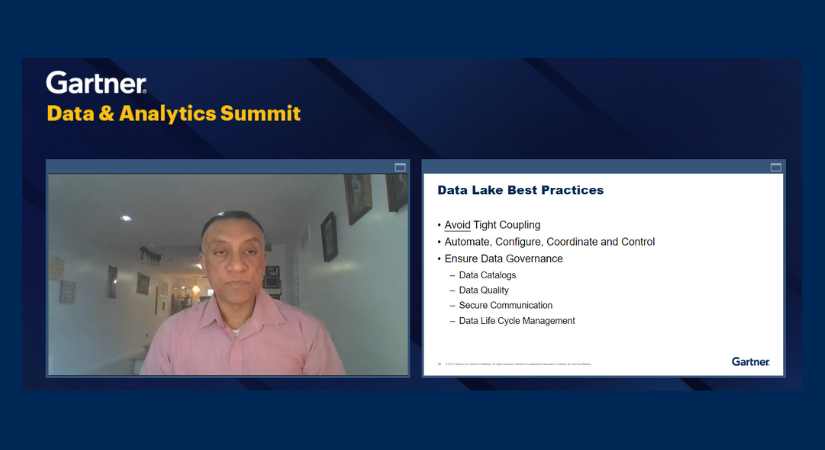
Building data lakes successfully requires data and analytics (D&A) leaders to integrate different technologies because there is no one end-to-end product in the market to implement them across the enterprise. In this session, Sumit Pal, Sr. Director Analyst at Gartner, explored the best practices of building data lakes infrastructure successfully and some of the challenges.

Key Takeaways

  • Best Practice #1: Avoid Tight Coupling. “Build the correct interface-based approach design.”

  • Best Practice #2: Automate, Configure, Coordinate and Control. “Nothing should be happening manually. It should all be automated, configured, coordinated and controlled with the right tools.”

  • Best Practice #3: Ensure Data Governance. “Build the right kind of data catalogs; have the right data quality; secure communications; and manage the data life cycle.”

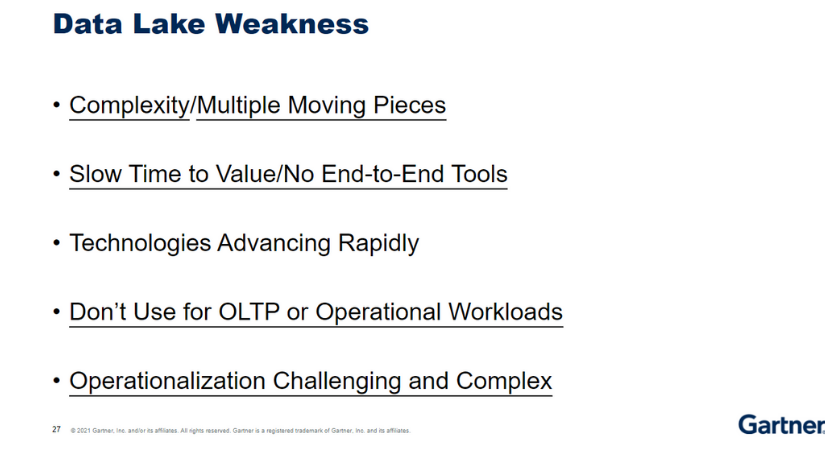
  • “Data lakes have multiple moving pieces hence data lakes are complex to build. D&A leaders must be aware of their weaknesses, which include that data lakes provide slow time to value and cannot be used for online transaction processing or operational workloads.”

Learn how to use data & analytics to re-engineer decision making in the free Gartner e-book “The Future of Decisions.”

Why Small and Wide Data Are the Future of AI

Presented by Jim Hare, Distinguished VP Analyst, Gartner

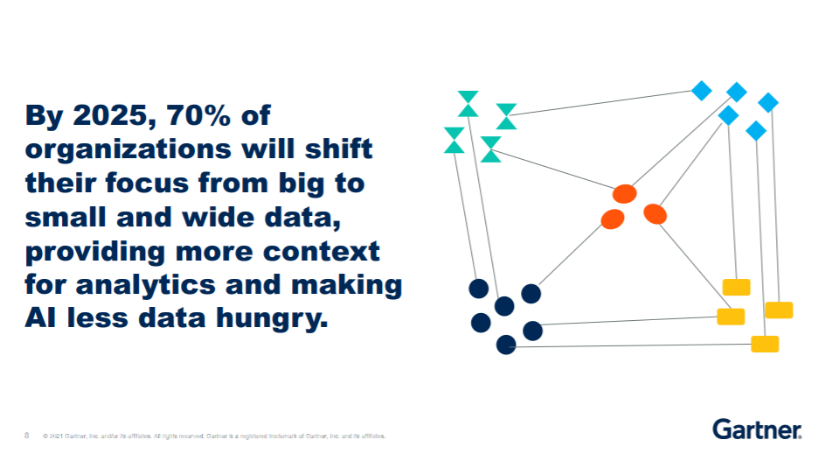
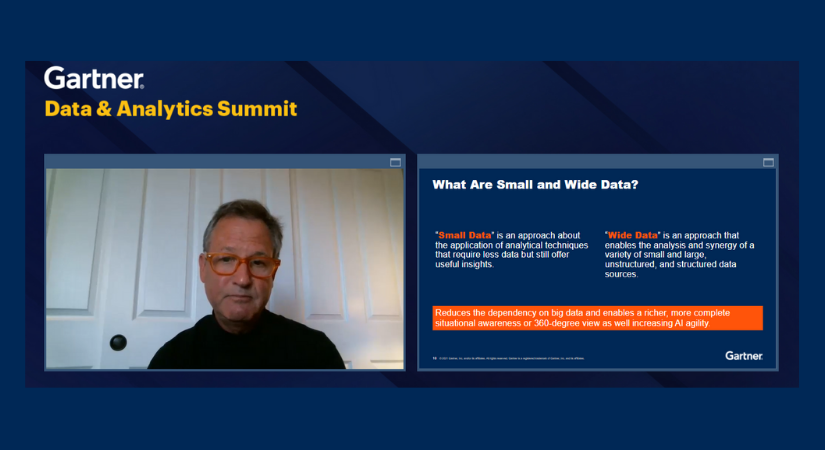
As organizations experience the limitations of big data as a critical enabler of analytics and artificial intelligence, new approaches known as 'small data' and 'wide data' are emerging. In this session, Jim Hare, Distinguished VP Analyst at Gartner, explained what small and wide data are and why they matter.

Key Takeaways

  • “Small data looks at analytical techniques that require less data,but offers useful insights.”

  • “Large data gives us the context. It allows organizations to use more of their data to enrich their existing data.”

  • “Both approaches reduce an organisation’s dependency on big data and enable a richer, more complete situational awareness or 360-degree view.”
  • “Small and wide data give D&A leaders more explainability than what they get from big data approaches. They make AI more resilient, focused and less data hungry.”

Learn more in the Gartner press release, "Gartner Says 70% of Organizations Will Shift Their Focus From Big to Small and Wide Data By 2025."

Myths and Pitfalls of Artificial Intelligence and How to Navigate Them

Presented by Alexander Linden, VP Analyst, Gartner

Even as enterprise artificial intelligence (AI) maturity grows, many myths persist about this technology. In this session, Alexander Linden, VP Analyst at Gartner, discussed the most common myths and pitfalls facing AI and machine learning experts.

Key Takeaways

  • Myth #1: AI capabilities surpass human capabilities. “The deception is that they allowed the computer top five accuracy metrics. This means that the computer was allowed to make five guesses, and only one of those guesses has to be correct for the system to score ‘correct.’”

  • Myth #2: AI is disrupting industries. “When you apply AI it has so many use cases, which all will result in better cost savings, customer satisfaction, downtime reduction, risk reduction and more, but all these things that we’re going to see be better don’t necessarily translate into huge disruption.”

  • Myth #3: AI is about intelligence. “The systems that we create don’t understand much, they only react.”

  • Myth #4: AI can do anything. “The spectrum of problems that AI can tackle is surprising, but we have to say that AI is a point solution. A solution for fraud detection is not going to drive cars.”

  • Myth #5: AI will replace human intelligence. “With our flexibility to learn things, to understand things, and to be super fast and adaptive, it will take a long while before AI will replace human intelligence.”
  • Myth #6: AI can learn on its own. “If you look at the whole lifecycle of AI, only the advanced analytics is fully automated.”

It’s not too late to join the conference!

About Gartner

Gartner, Inc. (NYSE: IT) delivers actionable, objective insight that drives smarter decisions and stronger performance on an organization’s mission-critical priorities. To learn more, visit gartner.com.

Contacts

It's not too late to join the conference

Latest Releases