ORLANDO, Fla., May 7, 2025
- Gartner client? Log in for personalized search results.
Gartner Supply Chain Symposium/Xpo 2025 Orlando: Day 3 Highlights
Media contact
Justin Lavelle
Gartner
justin.lavelle@gartner.com
Overview
We are bringing you news and highlights from the Gartner Supply Chain Symposium/Xpo, taking place this week in Orlando, Florida. Below is a collection of the key announcements and insights coming out of the conference. You can read the highlights from Day 1 here and Day 2 here.
On Day 3 from the conference, we are highlighting sessions on supply chain technology trends, AI and change management. Be sure to check this page throughout the day for updates.
Key Announcements
- Gartner Identifies Three Strategies for Chief Supply Chain Officers to Deliver Value Amid Heightened Uncertainty and Divergent Outcomes
- Complex Supply Chains Need Decision Shapers
- Gartner Predicts 60% of Supply Chain Digital Adoption Efforts Will Fail to Deliver Promised Value by 2028
Signature Series: Supply Chain Technology Trends
Presented by Kaitlynn Sommers, Senior Director Analyst, Gartner
With 98% of supply chain organizations planning or already implementing a digital initiative in the next two years, it is vital to understand emerging supply chain technologies, and their potential to support transformative business outcomes. In this session, Kaitlynn Sommers, Senior Director Analyst at Gartner, highlighted the most impactful supply chain technology trends of 2025.


Key Takeaways
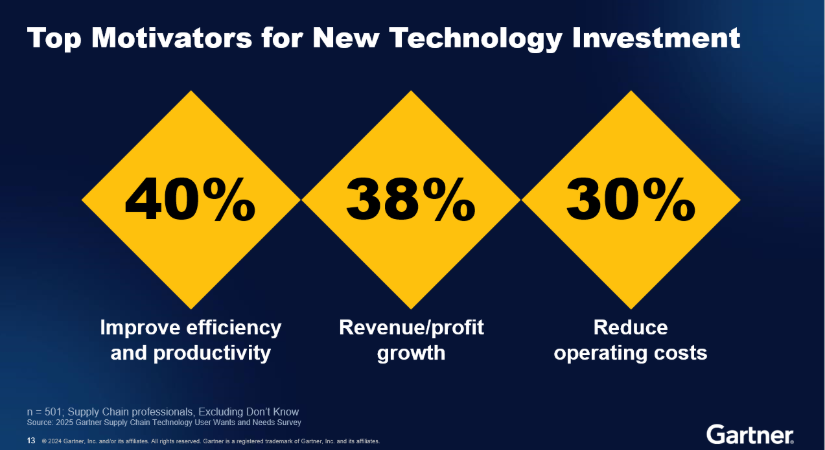
“The top motivators for new supply chain technology investment include: improving efficiency, revenue and profit growth, and reducing operating costs.”
“The two themes that connect this year’s trends are connectivity and intelligence.”
“The Augmented Connected Workforce leverages digital tools and data management techniques to integrate their interactions with both physical and virtual surroundings.”
“Polyfunctional robots are machines that will be capable of taking on multiple tasks, following human instruction or example without explicit programming or hardware modification.”
- “Agentic AI enables a virtual workforce of AI agents that can assist, offload and augment human work or traditional applications.”
Journalists can receive additional information and/or request an interview with the Gartner expert by contacting Justin Lavelle at justin.lavelle@gartner.com.
Supply Chain’s AI Report Card: Successes, Challenges, and the Path Forward
Presented by Sam Berndt, VP Research, Gartner
Among supply chain organizations that have started their AI journeys, two-thirds have scaled deployments of both traditional AI systems and newer generative applications. While many report early successes, challenges lurk under the surface. In this session, Sam Berndt, VP Research at Gartner, provided a report card documenting the early wins and challenges for AI in the supply chain, along with outlining a future implementation roadmap.

Key Takeaways
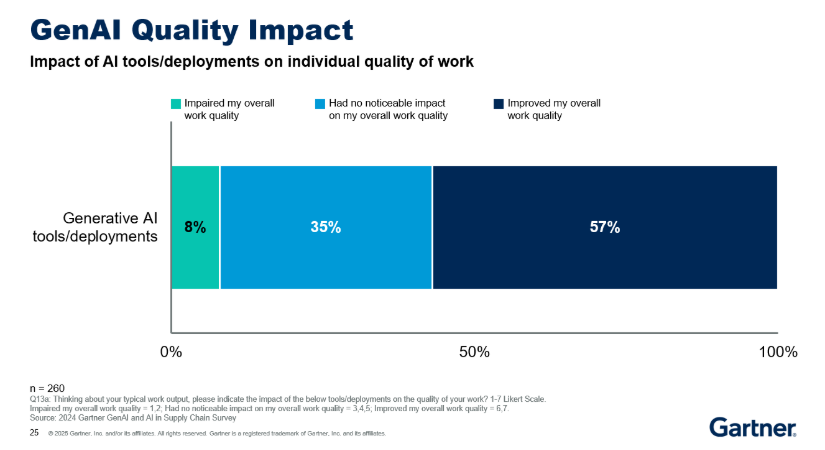
- “Non-generative AI tools are reducing the time employees spend on tasks, with 89% reporting a positive or neutral effect on their work quality.”
“While 70% of supply chain leaders agree on the importance of utilizing AI to reengineer critical supply chain tasks, only 8% have actually implemented these changes.”
“Early GenAI productivity signals have been good; 89% report reduced time on tasks and 68% report improved work output.”
“Beneath the surface, there are challenges with GenAI productivity, including individual productivity gains not yet translating to the team level.”
“Emerging AI trends for supply chain leaders to monitor include: Agentic AI, Emotion Al and synthetic data support.”
Journalists can receive additional information and/or request an interview with the Gartner expert by contacting Justin Lavelle at justin.lavelle@gartner.com.
Reframing Resistance to Change
Presented by Lorraine Gavin, Senior Principal Analyst, Gartner
Supply chain employees are confronted by more frequent and larger changes that are broader in scope. Resistance to change is natural and leaders can use this reaction to gather information and improve their processes. In this session, Lorraine Gavin, Senior Principal Analyst at Gartner, highlighted how resistance can be reframed as a positive when leaders have adequate tools and strategies to manage it.


Key Takeaways
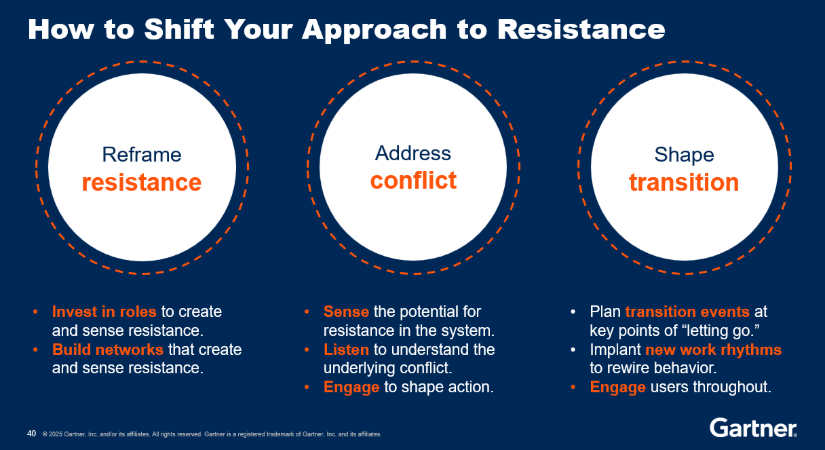
“Leaders should reframe resistance from something to be avoided to a mechanism for receiving critical information.”
“Organize specific change management roles to be ‘sensors of resistance’ who can collect information and report back to leadership on pain points, so that they can be addressed.”
“Resistance to change is rooted in conflicts related to risk, loss, priority and time. Understand which conflict you need to overcome and address it.”
“Rather than telling employees what to do, ask them: ‘what would it take for this to be successful?’”
“Viewing transitions as a three-phase process provides opportunities to communicate, design structured user events, and provide training and support as new processes are designed, deployed and adopted.”
Journalists can receive additional information and/or request an interview with the Gartner expert by contacting Justin Lavelle at justin.lavelle@gartner.com.
That's a wrap on Gartner Supply Chain Symposium/Xpo, in Orlando. Until next year!


Latest releases
About Gartner
Gartner (NYSE: IT) delivers actionable, objective business and technology insights that drive smarter decisions and stronger performance on an organization’s mission-critical priorities. To learn more, visit gartner.com.