KOCHI, India., November 18, 2026
AI's Elusive ROI: How to Track, Manage and Demonstrate Value
December 17 2026
KOCHI, India., November 18, 2026
Gartner, Inc., a business and technology insights company, identified the top strategic technology trends in software engineering for 2026 and beyond. Gartner analysts unveiled the trends during Gartner IT Symposium/Xpo, taking place here through today.
“The rapid advancement of AI is reshaping the software development life cycle (SDLC), forcing software engineering leaders to balance immediate productivity gains with longer-term investments in operating models, skills and governance,” said Manjunath Bhat, Distinguished VP Analyst at Gartner. “By understanding these trends and their impact, software engineering leaders can maximize AI’s value across the SDLC, enabling teams to deliver AI-powered applications faster, at greater scale and with sustainable business outcomes.”
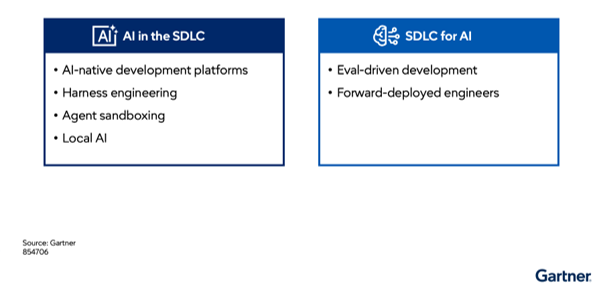
Software engineering leaders should evaluate how these six trends will affect their AI strategies, engineering practices and operating models in 2026 and beyond. Gartner groups the trends into two themes: AI in the SDLC and SDLC for AI (see Figure 1). For CIOs, AI SDLC capabilities are a key lever for reengineering legacy software applications, accelerating IT modernization and reducing application maintenance costs.
Source: Gartner (November, 2026)
AI-Native Development Platforms
AI-native development platforms provide the foundation for AI-native software engineering and help reduce friction across the SDLC. These platforms range from vibe-coding tools that enable software creation without deep technical expertise to AI coding agents orchestrated by professional developers.
Gartner predicts by 2030, enterprise application portfolios will include 40% custom applications built using AI-native development platforms, up from 2% in 2025. To prepare for this shift, software engineering leaders should adopt an AI-first approach and establish the platform capabilities and governance needed to enable secure, scalable AI-native development.
Harness Engineering
Harness engineering enables organizations to configure AI coding agents with the context, standards and guardrails needed to execute software engineering tasks reliably. By using agent harnesses to ground AI agents in organizational knowledge, governance and workflows, organizations can improve the quality, consistency and scalability of AI-generated outputs.
Gartner predicts that by 2028, organizations with AI coding harness infrastructure will experience 60% fewer post deployment defects than those without. As performance differences between frontier AI models narrow, harness engineering will become a more important determinant of output quality than the choice of model itself.
Agent Sandboxing
Agent sandboxing uses trusted agent execution environments with strong isolation controls to reduce business and security risks associated with AI coding agents. Gartner predicts that by 2030, 70% of enterprises will sandbox agentic development workflows in preproduction environments, up from 10% in 2026.
“Organizations are increasingly looking to scale AI agents beyond experimentation and into production,” said Bhat. “Agent sandboxing provides a secure foundation for this shift, enabling teams to experiment while protecting systems from unintended agent-driven actions, untrusted code execution and privilege escalation.”
Local AI
Local AI is a deployment strategy that enables organizations to run AI models and agents within their own infrastructure rather than relying primarily on vendor-hosted aapplication programming interfaces (APIs). As AI moves from experimentation to production, organizations are adopting local AI to address data sovereignty concerns, manage rising inference costs and support latency-sensitive workloads.
Gartner predicts that by 2028, 60% of regulated enterprises will migrate AI workloads to local infrastructure after discovering that provider headquarters location, rather than data location, determines government access.
Eval-Driven Development
Eval-driven development uses task-specific evaluations to assess GenAI and agentic AI applications against predefined quality criteria, helping organizations quantify, measure and improve accuracy, safety, trust and explainability. Gartner predicts that by 2028, 70% of software engineering teams will adopt an eval-driven development approach to build responsible and trustworthy AI, up from less than 20% in 2026.
Forward-Deployed Engineers
Forward-deployed engineers (FDEs) work directly with business and technology teams to accelerate deployment of AI solutions in real-world customer environments. By combining software engineering expertise with domain knowledge and business context, FDEs help organizations move faster from AI concepts to production outcomes.
Gartner predicts that by 2028, more than 70% of AI technology and service providers will leverage FDEs to accelerate AI solution adoption, up from 10% today.
Gartner clients can read more in Top Strategic Technology Trends in Software Engineering for 2026, 2H Update.
Gartner is the indispensable partner to C-Level executives and technology providers as they implement AI strategies to achieve their mission-critical priorities. The independence and objectivity of Gartner insights provide clients with the confidence to make informed decisions and unlock the full potential of AI. Clients across the C-Level are using Gartner's proprietary AskGartner AI tool to determine how to leverage AI in their business. With more than 2,500 business and technology experts, 6,000 written insights, as well as more than 1,000 AI use cases and case studies, Gartner is the world authority on AI. More information can be found here
Gartner IT Symposium/Xpo is the world's most important gathering for CIOs and other IT executives. CIOs and IT executives rely on these conferences to learn how to become agents of change in their organizations and harness AI for successful digital transformation. Follow news and updates from the conference on X and LinkedIn using #GartnerSYM, and on the Gartner Newsroom.
Gartner for Software Engineering Leaders helps leaders align with stakeholders, retain and optimize teams and build innovative products that support and serve the entire organization, its partners and clients. Additional information is available at https://www.gartner.com/en/software-engineering.
Follow news and updates from Gartner for Software Engineering Leaders on X and LinkedIn. Visit the Gartner Newsroom for more information and insights.
Sonika Choubey
Gartner
sonika.choubey@gartner.com
Gartner (NYSE: IT) delivers actionable, objective business and technology insights that drive smarter decisions and stronger performance on an organization’s mission-critical priorities. To learn more, visit gartner.com.


