See how chief sales officers can make AI investments pay off.
- Gartner client? Log in for personalized search results.
Seller distrust of AI blocks data-driven sales transformation
Gartner finds that 66% of sales leaders report low trust in AI-generated insights within their organizations. This lack of trust keeps sales teams from using AI to drive growth. Sellers ignore AI tools because the advice is too generic or factually wrong for their specific deals. The problem is not the technology; it’s that AI lacks the contextualized data required to deliver trusted recommendations. While an organization’s most valuable data is essential for AI to deliver ROI, that same data is often hard to use, expose or operationalize due to fragmentation, sensitivity, governance constraints or poor readiness.
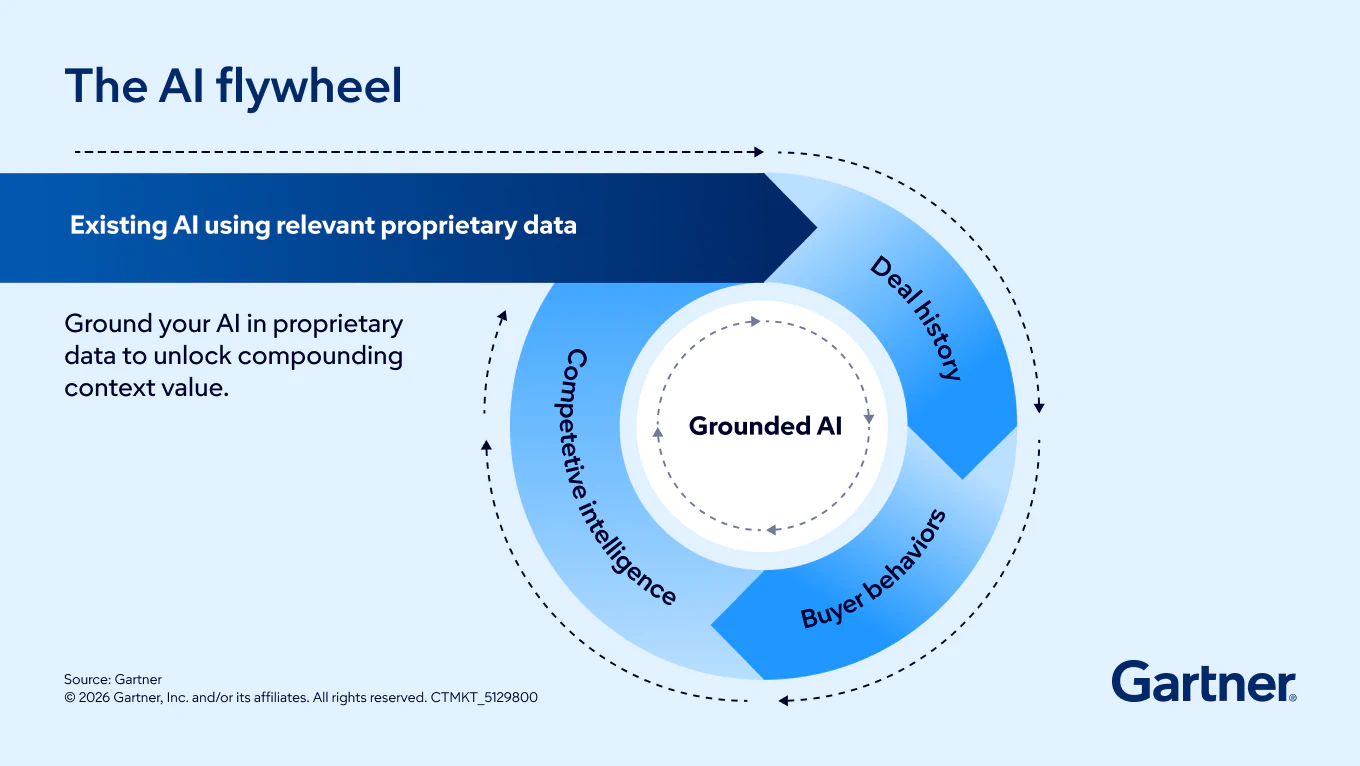
Driving adoption and trust requires feeding AI high-quality, proprietary data on deal history, buyer behaviors and competitive intelligence. This data creates an AI flywheel — a compounding advantage where every deal makes the next recommendation better.
You might also like this webinar: Outsmart Disruption: Using AI to Build Unbreakable Sales Organizations
A framework to ground AI in proprietary data and build seller trust
Chief sales officers can close the trust gap and unlock the full value of AI investments with this framework to build an AI flywheel that grounds AI in high-quality data.
Fuel AI tools with clean data and human oversight.
As Gartner Senior Director Analyst Paul Vignati notes, “When a generic AI suggests a strategy that would kill a live deal, the trust gap widens, and your middle 60% simply revert to their old, manual ways of working.” Clean, reliable data is the foundation of trust — and action. Govern and improve data quality with these steps:
Treat internal deal data as the primary fuel for AI.
Fix CRM hygiene, validate deal notes and define AI’s role as reflecting the organization’s single source of truth.
Use human-in-the-loop gating (manager review of AI outputs) until trust is established.
Diagnose and unify fragmented data sources tied to priority use cases before broad automation.
Create a secure, cross-functional space for testing and governing AI.
Gridlock between sales, IT and legal teams can stall AI initiatives and cause pilots to die in cross-functional approval queues. To support collaboration and adoption across teams you should:
Remove cross-functional gridlock by creating a secure “commercial sandbox” for testing AI on real account history.
Lead discussions with IT and legal to define controlled scope, anonymization and governance.
Define clear data governance protocols that enable speed without compromising security.
Catalyze value for the wider team with a lab for decision rehearsal.
When AI is launched to the entire sales force without targeted proof of value, sellers remain skeptical, adoption lags and usage is superficial. Instead CSOs can:
Launch a controlled field lab with a sub-set of sellers to run “decision rehearsal” using real historical data and objections.
Share success stories where AI recommendations match experienced seller decisions and reduce precall research time.
Build a structured 90-day enablement plan for the whole team to strengthen belief, create habits and foster ownership of AI-integrated workflows
Evaluate progress and track success.
To ensure your efforts are increasing the value of AI for sellers, CSOs can:
Measure the percentage of AI outputs that correctly reference proprietary CRM data without human correction, aiming for a target of >85% accuracy.
Measure the impact on sellers and deals via two key metrics:
Workflow lift: Reduction in time spent on non-selling administrative tasks with a target of >20% reduction
Systemic revenue productivity: Lift in quota attainment for the middle 60% of performers utilizing grounded AI tools targeting >10% lift.
With shrewd AI investments paired with high-quality proprietary data you can achieve higher ROI from AI tools that sellers trust and want to use.
What’s next?
Executing AI-driven workflow transformations is one critical step in the CSO’s mandate to reimagine sales productivity in the AI era.
The other steps in this imperative include:
Aligning AI strategy to productivity gaps by fundamentally reimagining workflows around productivity objectives, challenging assumptions and aligning sellers and technology where each has a competitive advantage.
Building a tech-enabled operating rhythm by embedding calculation, monitoring and validation of productivity into AI-driven systems and the supporting operations layer, using technology to streamline workflows, reduce decision fatigue and sustain high‑value performance gains.
Pinpointing productivity and performance levers by breaking down business objectives into actionable productivity outcomes while rigorously challenging model assumptions
Isolating key metrics and related workflows by decoupling processes from traditional headcount assumptions, identifying which activities drive results, aligning impact metrics to workflows and establishing new baselines with productivity measures independent of FTE.
For more on how Gartner helps drive success on this and other mission-critical priorities for CSOs, speak to us today.
AI for sellers FAQs
Why do sellers distrust AI recommendations ?
Sellers distrust AI because generic recommendations often miss deal context and provide guidance that is factually wrong or too broad. The root cause isn’t the technology — it’s the lack of proprietary, contextual data that makes AI outputs relevant and actionable for specific deals.
How can proprietary data improve seller trust and adoption of AI tools?
Feeding AI high-quality proprietary data — such as deal history, buyer behaviors and competitive intelligence — transforms generic advice into tailored recommendations. Gartner finds that trust in AI tools drops by 60% when sellers doubt data accuracy. Clean, reliable data fuels AI credibility and drives adoption by creating an AI flywheel for grounded AI, making every recommendation more relevant and accurate.
What metrics should sales leaders track to measure AI tool success?
Sales leaders should track the percentage of AI outputs referencing proprietary CRM data without human correction (target >85% accuracy). Gartner also recommends measuring workflow lift (aim for >20% reduction in admin tasks) and systemic revenue productivity (target >10% lift in quota attainment for the middle 60% of performers using grounded AI tools).
Attend a Conference
Join Gartner analysts and your peers to accelerate growth
Gather alongside your peers in Las Vegas to gain insight on emerging trends, receive one-on-one guidance from a Gartner analyst and create a strategy to tackle your priorities head-on.
18 – 19 May 2027
Gartner CSO & Sales Leader Conference
Las Vegas, NV

Drive stronger performance on your mission-critical priorities.