Evergreen capabilities help employees adapt as AI changes how work happens.
- Gartner client? Log in for personalized search results.
Why AI skills strategies are becoming overwhelming
Organizations are accelerating AI adoption, yet workforce readiness continues to lag behind. Gartner found that 95% of CHROs report active AI initiatives, while 51% of CIOs and senior IT leaders believe required skills are evolving faster than available talent.
Many organizations respond by adding new skill requirements every time AI capabilities advance. The result is often workforce confusion rather than workforce readiness.
“Organizations can no longer afford to overwhelm employees by continually chasing new skill priorities without a clear framework and must instead focus on developing evolutionary capabilities that progress alongside the way AI impacts work,” says CV Viverito, Senior Director Analyst at Gartner.
You might also like this webinar: Strategic Roadmap: Redesigning HR for an AI‑Infused Operating Model
Build capabilities that evolve with work
Organizations should prioritize fewer skills that have the potential to evolve as AI reshapes work, not an ever-expanding list of AI skills.
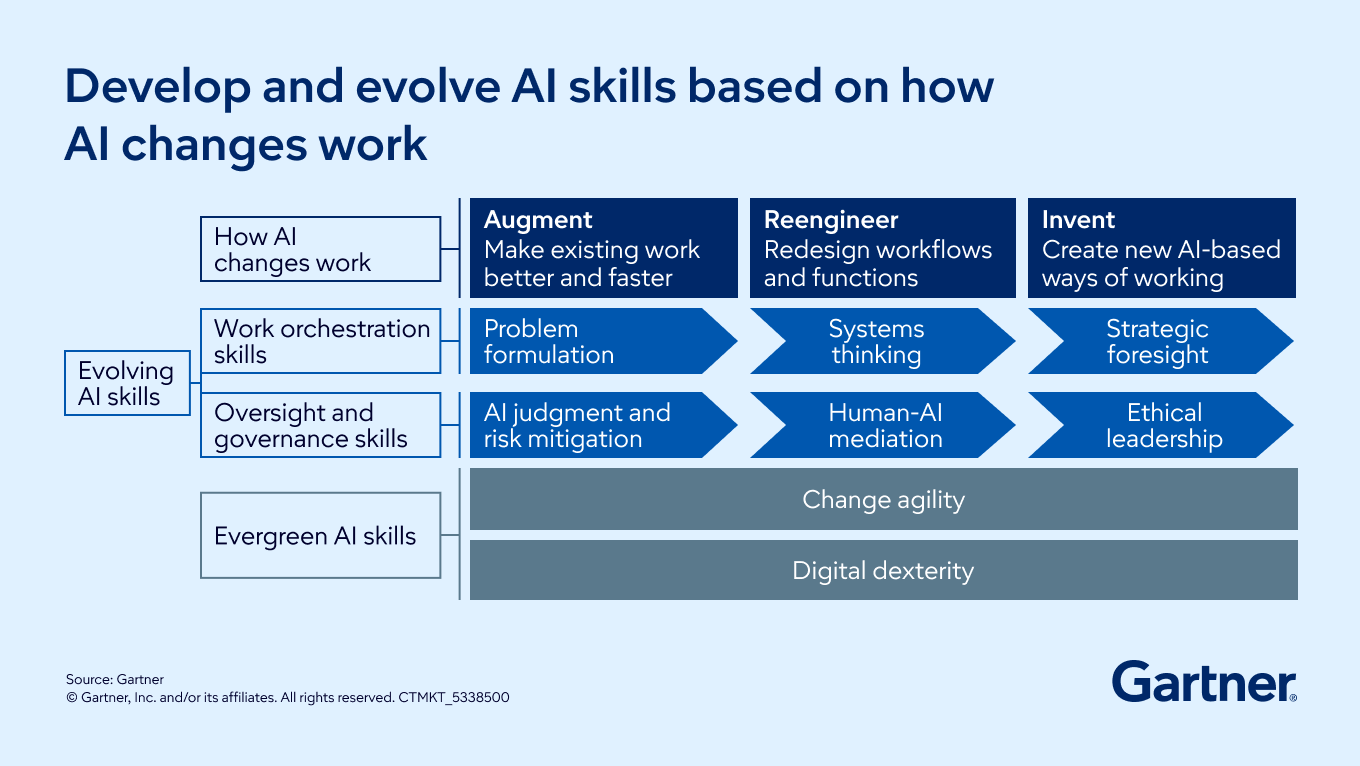
Prioritize skills based on how AI changes work
According to Gartner, organizations should develop capabilities based on whether AI is:
- Augmenting work, making existing tasks faster and more efficient. Prioritize problem formulation and AI judgment and risk mitigation.
- Reengineering work, redesigning workflows and functions. Prioritize systems thinking and human-AI mediation.
- Inventing new work, creating entirely new AI-driven ways of working. Prioritize strategic foresight and ethical leadership.
This approach gives employees greater clarity on which capabilities matter most as AI changes the way work gets done.
Anchor workforce readiness in evergreen capabilities
Not every capability should change as AI evolves. Gartner recommends anchoring workforce development in evergreen skills that remain valuable even as technologies, tools and workflows change.
Two capabilities stand out:
- Change agility, which helps employees navigate continual AI-driven transformation. Gartner found that employees with change agility are 1.6 times more likely to achieve high performance in the AI era.
- Digital dexterity, which enables employees to continually integrate new technologies into their work as platforms and tools evolve.
Together, these capabilities create a foundation that supports workforce readiness, regardless of how AI continues to develop.
Measure workforce readiness through business impact
Workforce readiness should be measured by more than completed training courses or skills inventories. CHROs should evaluate whether capability development is helping employees drive value from AI.
According to Gartner, organizations can assess progress by monitoring:
- AI skills proficiency through both self-assessments and peer reviews
- Participation in experiential (not just static) AI learning activities
- Productivity and business outcomes, such as reduced cycle times, increased output and faster time to market
- Reduction in AI-related compliance and ethical incidents
- Employee engagement and retention among participants in AI capability development programs
AI skills FAQs
Why is workforce readiness lagging behind AI adoption?
Gartner found that while 95% of CHROs report active AI initiatives, 51% of CIOs and senior IT leaders believe required skills are evolving faster than talent supply. Many organizations continue adding new skill requirements without a framework for prioritization.
How should CHROs prioritize AI skills?
CHROs should prioritize capabilities based on how AI is changing work. Gartner recommends developing different evolutionary capabilities depending on whether AI is augmenting, reengineering or inventing work.
Which workforce capabilities remain valuable as AI evolves?
Gartner identifies change agility and digital dexterity as evergreen capabilities that help employees adapt as technology changes. These skills provide a durable foundation for workforce readiness in the AI era.
Attend a Conference
Join Gartner analysts and your peers to accelerate growth
Gather alongside your peers in Orlando to gain insights on emerging trends, receive one-on-one guidance from a Gartner expert and create a strategy to tackle your priorities head-on.
26 – 28 Oct 2026
Gartner HR Symposium/Xpo™
Orlando, FL

Drive stronger performance on your mission-critical priorities.