Highlights from the 2026 Gartner Finance Symposium/Xpo™ opening keynote on how CFOs are translating AI into measurable advantage
- Gartner client? Log in for personalized search results.
The AI Gains Divide Is Widening: What CFOs Must Do Next
From Gartner Finance Symposium/Xpo | June 12, 2026
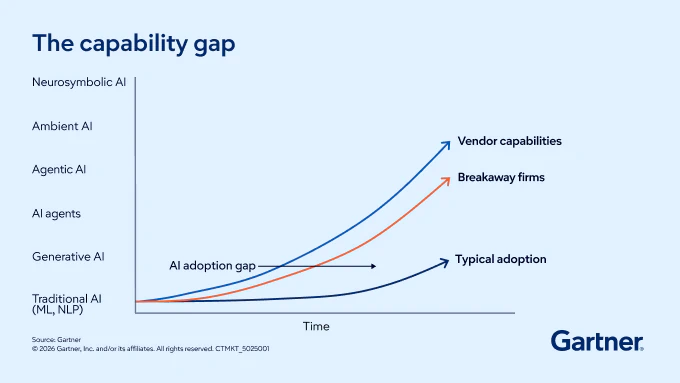
AI gains are increasingly asymmetric
AI is tilting the playing field. A small group of firms are pulling ahead, capturing significant and compounding gains from AI, while most are stalled in early deployment.
Only 19% of firms are seeing real benefits, and just 12% have scaled AI across their business. The difference is not just the technology, it’s the environment into which that technology is deployed.
See Gartner insights in action at our finance conferences and events.
What sets breakaway winners apart in AI adoption
The gap is growing. The most AI-mature organizations are seeing faster returns, which fuel further investment and accelerate their advantage.
Meanwhile, the majority are seeing marginal gains, unable to catch up with firms who are unlocking new sources of value. This dynamic is not new: In the early 2000s, frontier firms that embraced digital technology saw productivity soar by over 60% between 2003 and 2016, while others saw minimal improvement. AI is following a similar path: rewarding organizations that rethink how work gets done, not just the tools they use.
The real edge: Building an AI-ready ecosystem
Breakaway firms aren’t just installing new tech, they’re overhauling how they work. They are redesigning processes, data flows, governance and culture to fully capture AI’s potential.
Leading organizations focus on five key shifts:
Investing disproportionately in upside, rather than efficiency. They target AI at decision-making, core operational processes and growth opportunities, not just automating routine work.
Making knowledge accessible to machines. They document expertise in ways AI can actually use, such as recorded calls, prompt libraries and knowledge graphs.
Governing to accelerate. They design governance as a reusable asset that acts as a sort of design template, allowing them to more quickly deploy AI systems.
Building frictionless data supply chains. They focus on moving and transforming data so AI can use it, instead of chasing perfect data.
Empowering everyone to build. From CFOs to analysts, everyone’s expected to use AI to build tools, automate and analyze as part of their work.
Aim higher than automating the small stuff
The best firms are moving beyond automating low-value tasks. They’re using AI to rethink their most important work, to make faster, smarter decisions and find new ways to grow. Firms that prioritize these “upside” opportunities are twice as likely to see major gains. This is not to say that they don’t find efficiency gains — they just tend to harvest them as a byproduct of other work than as the intent. The old mindset — automate the grunt work and redeploy people to high-value tasks — is outdated. Now, AI is increasingly being applied to high-value analytical work — augmenting, rather than replacing, human expertise.
Make your expertise machine-readable
If knowledge exists only in employees’ heads or scattered documents, AI can’t help you. Breakaway firms treat knowledge as an asset: They capture and structure it so AI can access, update and use it to generate real insights. This context engineering is the difference between AI that disappoints and AI that delivers.
Governance, data and a culture of builders
Breakaway firms don’t see governance as red tape — they see it as scaffolding that speeds up innovation while keeping risks in check. Their data supply chains ensure AI has what it needs, and they’re already seeing results from formal data products. Most importantly, they make building technology everyone’s job.
With agentic coding tools, the barrier to creating new solutions is lower than ever. In these organizations, 70% of finance employees are “citizen digital talent,” and 20% are dedicated tech builders. The future of finance belongs to those who build.
What to do next to lead the shift to AI-first finance
AI has ushered in the biggest transformation to finance since the spreadsheet, requiring CFOs to act as catalysts for fundamental change by leading the shift from legacy systems and mindsets to an agile, AI‑powered finance function. That vision marks the starting point of a broader journey CFOs must navigate to fully deliver on the mission‑critical priority of leading the shift to AI-first finance.
The steps in that journey include:
Redesigning finance teams, roles and ways of working to maximize AI’s benefits. This includes shifting responsibilities, updating talent profiles and evolving workflows so the function captures transformational — not just fractional — productivity gains.
Reviewing validated finance AI use cases, and applying best practices for identifying, prioritizing and piloting new opportunities. CFOs should also assess emerging vendors that can support evolving finance needs as use case complexity grows.
Assessing digital and technical capabilities required for successful finance AI implementation. That means deploying emerging best-practice solutions to build both the systems and the people capabilities needed to accelerate adoption and scale value.
Creating a finance AI roadmap that pushes the organization to go beyond automating low-value activities. Ensure the roadmap explicitly ties automation to clear financial outcomes.
Learning how to approach build‑versus‑buy decisions for finance AI solutions. Understanding where vendor capabilities lead or lag CFO expectations helps determine which capabilities are best sourced externally and which should be developed in‑house.
For more on how Gartner helps drive success on this and other mission-critical priorities for CFOs, speak to us today.
Finance at the AI forefront FAQs
Why are AI gains in finance so uneven?
AI gains in finance are so uneven because only a select group of firms are investing in the full ecosystem needed to unlock AI’s true potential. While many organizations focus mainly on acquiring the latest AI technology, the real differentiator is how well they build supporting assets, establish effective governance and create seamless data pipelines. Breakaway firms intentionally develop these elements, allowing them to capture compounding benefits and pull ahead of the competition. In contrast, most companies remain stuck in early deployment phases, unable to move beyond pilot projects or see significant, measurable value from their AI investments.
How do leading firms build an AI ecosystem?
Leading firms build an AI ecosystem by focusing on five essential pillars that go far beyond simply adopting new tools. First, they prioritize AI investments that drive upside, such as better decision making and revenue growth, rather than just automating routine tasks. Second, they capture and structure organizational knowledge in machine-readable formats, making it accessible for AI. Third, they design governance with automation and speed in mind, treating it as a reusable asset. Fourth, they develop robust data supply chains that prioritize accessibility and transformation over perfect data. Finally, they empower everyone in finance to build and innovate with technology.
Why does machine-readable knowledge matter?
Machine-readable knowledge is critical because it allows AI systems to tap into the unique expertise, context and decision history within your organization. Most valuable information in a company lives in people’s heads or scattered documents, making it inaccessible to AI. Leading firms invest in context engineering, systematically capturing and structuring knowledge so it can be used by AI systems. This enables AI to deliver more relevant, trustworthy and actionable insights. Firms that prioritize machine-readable knowledge consistently see higher returns from their AI initiatives, while those that don’t often experience disappointing results and limited impact from their technology investments.
Attend a Conference
Join Gartner analysts and your peers to accelerate growth
Gather alongside your peers in National Harbor to gain insight on emerging trends, receive one-on-one guidance from a Gartner analyst and create a strategy to tackle your priorities head-on.
2 – 4 Jun 2027
Gartner Finance Symposium/Xpo™
National Harbor, MD

Drive stronger performance on your mission-critical priorities.