Discover highlights from the Gartner IT Symposium/Xpo™ Opening Keynote on balancing AI value and risk to create lasting success.
- Gartner client? Log in for personalized search results.
Compounding risk is becoming AI’s biggest value challenge
Organizations are doing more with AI than ever before, yet the 2026 Gartner C-Suite AI Survey finds only one in five AI use cases delivers positive returns. At the same time, 86% of CIOs report that their AI risk is growing faster than AI value in their organization. CIOs also report that, on an average, risk is growing four times faster than value. As a result, the challenge facing CIOs is no longer simply adapting AI or launching new use cases. Now, it’s to ensure that AI creates compounding value rather than isolated successes, while also managing increasing risk.
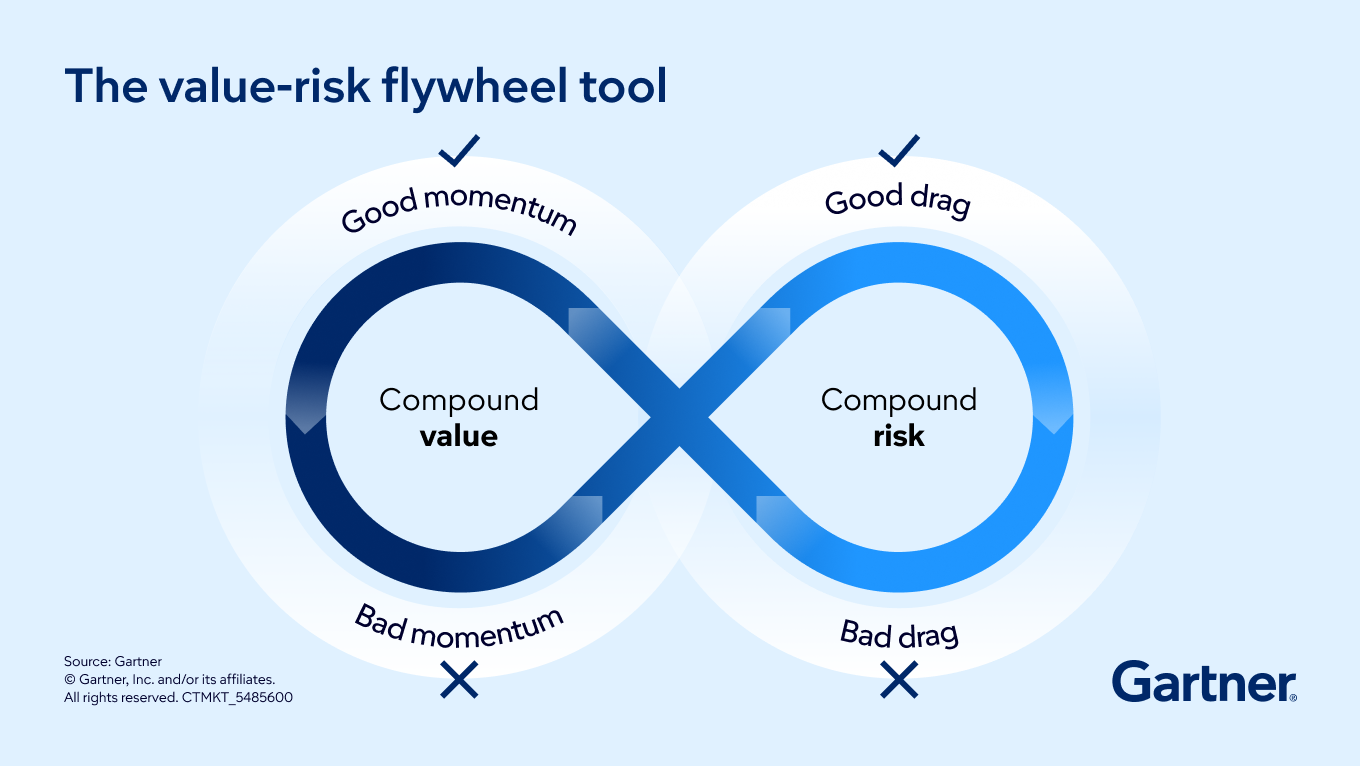
In the Opening Keynote at Gartner IT Symposium/Xpo, in Orlando, FL, Gartner Distinguished Vice President Analyst and Fellow Daryl Plummer and Distinguished Vice President Analyst Kristin Moyer introduced a new way for technology leaders to think about this challenge: the Gartner Value-Risk Flywheel. Rather than treating value and risk as opposing forces, leaders should view them as interconnected drivers that must be actively shaped. Success will come from creating the right momentum to compound value while preventing risk from compounding into harm.
You might also like this webinar: C-Suite AI Conversations: Ready to Fail vs. Ready to Scale
Use value and risk together to create sustainable momentum
CIOs should stop viewing AI as a collection of individual projects and start managing AI as a compounding system. When organizations build capabilities, expertise, governance and data that improve future outcomes, each success makes the next one easier, faster and more valuable.
Build compound value instead of compounding AI volume
Many organizations equate growth in AI activity with growth in business value. However, Gartner finds the average organization increased its number of AI use cases by more than 400% in a single year, yet the majority of their AI projects are failing to deliver positive ROI. Activity without value is simply bad momentum.
Instead of launching new projects, organizations should focus more on creating repeatable advantages. A successful initiative should create reusable capabilities, trusted governance, expertise and data assets that improve future results.
The goal is not to create more AI activity but to create outcomes where one success makes future successes easier, faster and more valuable. Organizations that repeatedly reinvent the wheel create more effort and more complexity, but not necessarily more value.
Build good momentum and introduce good drag
The Gartner Value-Risk Flywheel is shaped by two forces: momentum and drag. Momentum accelerates outcomes, while drag slows them down. However, neither force is inherently good or bad. Good momentum compounds value through trust, reuse, work redesign and scaling proven successes. Bad momentum creates activity, duplication and complexity without creating advantage.
The same principle applies to drag. Good drag protects value through governance, cybersecurity, accountability and spending discipline. Bad drag creates bureaucracy, bottlenecks and rework without reducing risk.
Organizations succeed when momentum and drag work together to reinforce value creation and scaling while containing risk. Leaders should identify sources of momentum and drag across major AI initiatives and assess whether they are creating long-term advantage or simply increasing future burdens. This approach is especially important as risks such as shadow AI, dark AI, technical debt, process debt and cybersecurity exposure continue to compound across the enterprise.
Govern AI through a central bank and put people to the rescue
As AI becomes embedded across people, agents, models and platforms, accountability becomes harder to see and harder to manage. To address this challenge, Gartner introduced the concept of an AI Central Bank. Rather than governing AI through disconnected functions, the AI Central Bank acts as a common control plane that brings together accountability and governance, technology integration, cost economics and shared intelligence. This approach helps organizations improve visibility, coordinate decisions and balance value with risk across the enterprise. It also helps address the invisible chains of accountability emerging as AI systems become more autonomous.
Yet technology and governance alone are not enough, people remain essential. People are the first responders to AI failures, the last line of defense against dark AI and the entrepreneurs who discover new ways to create value. CIOs should make “people to the rescue” their mantra, positioning people as both value drivers and risk mitigators in an increasingly AI-shaped enterprise.
AI value and risk FAQs
Why are organizations struggling to compound AI value?
According to Gartner, organizations are increasing AI activity but not necessarily increasing AI value. While 58% of functional leaders report positive value from AI initiatives, only one in five AI use cases delivers positive returns. Many successful projects remain isolated rather than creating capabilities that make future initiatives easier, faster or more valuable.
What is the Gartner Value-Risk Flywheel?
The Gartner Value-Risk Flywheel is a framework that helps organizations analyze the relationship between compounding AI value and compounding AI risk. It recognizes that value and risk are interconnected outcomes shaped by momentum and drag, helping leaders assess, communicate and manage AI outcomes across the enterprise.
What is an AI Central Bank?
The AI Central Bank is a Gartner concept for a common control plane that coordinates accountability and governance, technology integration, cost economics and shared intelligence. Its purpose is to improve visibility, strengthen accountability and help organizations balance AI value and risk as AI adoption expands.
Attend a Conference
Experience CIO and IT Executive conferences
With exclusive insights from Gartner analysts on the latest trends, sessions curated for your role and unmatched peer networking, Gartner conferences help you accelerate your priorities.
19 – 22 Oct 2026
Gartner IT Symposium/Xpo™
Orlando, FL

Drive stronger performance on your mission-critical priorities.