Volatility is reshaping the demands on CFO leadership.
- Gartner client? Log in for personalized search results.
Persistent uncertainty is testing traditional leadership approaches
Geopolitical instability, rapid technological change, climate-related events and shifting economic conditions have made uncertainty a permanent feature of business leadership. As such, decisions that once seemed straightforward (about growth, resilience and risk) now require leaders to evaluate a wider range of possible outcomes while balancing the expectations of boards, investors, employees and customers.
The instinctive response is often to work harder, stay involved longer and increase oversight. But that approach has its limits. Over time, it increases burnout risk and hampers the organization’s ability to make sound decisions. Your challenge is no longer simply responding to disruption. It’s maintaining leadership effectiveness when disruption becomes constant.
You might also like this webinar: How Leading CFOs Strengthen Performance
Sustained volatility requires a different leadership model
Sustained volatility can quickly invalidate assumptions about resilience and growth, placing greater strain on leadership and governance models.
The most effective CFOs recognize that not every decision deserves the same level of executive involvement. Rather than spreading attention evenly across the organization, they redesign governance so executive attention is focused where it can have the greatest impact on resilience and growth.
“One of the few controllables in the CFO’s arsenal to remedy the chaos is to evolve their leadership approach using an adaptable governance model that prioritizes their time to the most impactful emerging business challenges,” says Dymah Paige, Director Analyst at Gartner.
The role of the CFO increasingly becomes that of a decision architect, designing how critical decisions are made rather than personally making every decision.
Not every business unit or market faces disruption in the same way. The most effective CFOs do not distribute leadership attention equally across the organization. They adjust governance, decision rights and executive involvement according to the level of risk, resilience and adaptability within each part of the business.
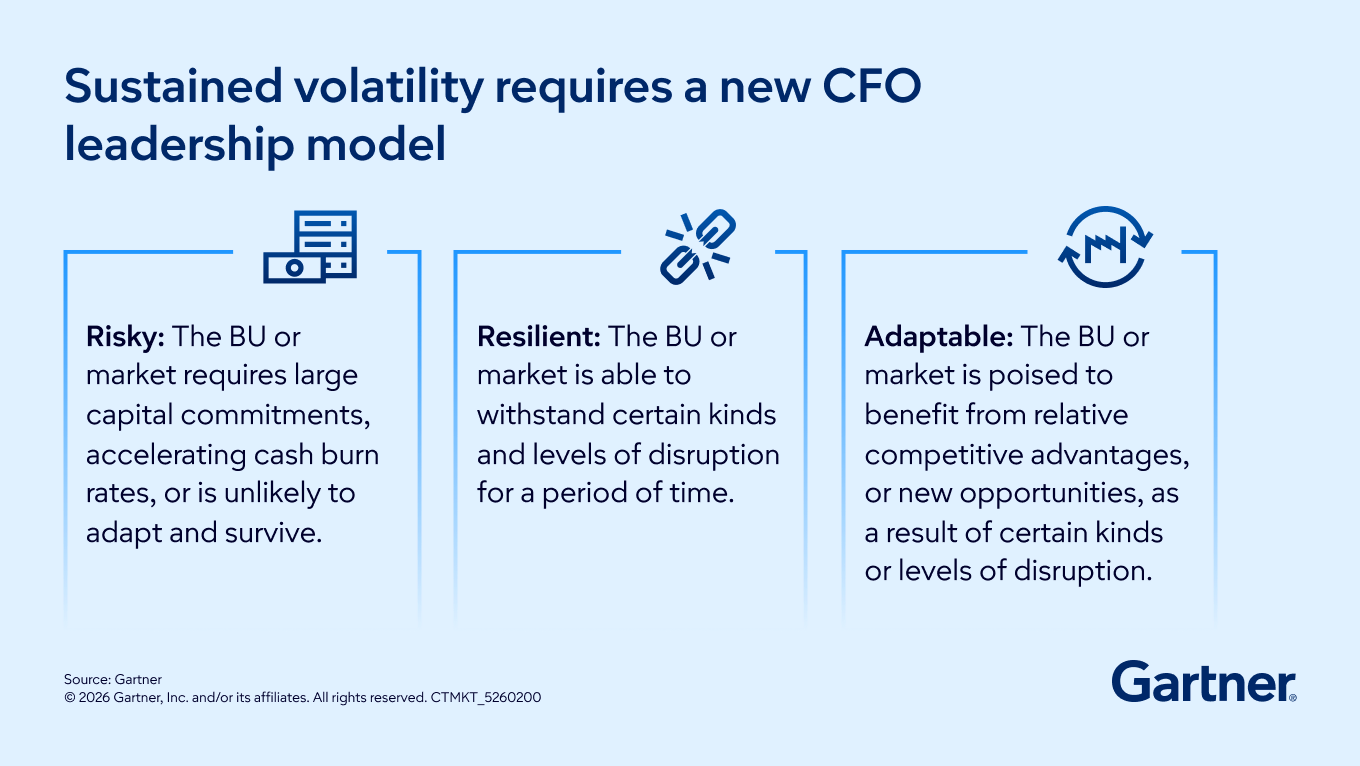
As you assess business units and markets, consider how governance should differ across three categories:
Risky: Areas facing significant disruption, capital exposure or liquidity concerns that require greater executive oversight and faster escalation paths.
Resilient: Areas capable of operating effectively through disruption with broader delegation and streamlined governance.
Adaptable: Areas positioned to benefit from changing market conditions and deserving increased strategic attention.
Identify where disruption creates the greatest risk
Stress-test business units and markets to identify where disruption poses the greatest threat to resilience, liquidity and long-term performance. These risky areas often warrant more centralized decision making and greater executive involvement.
Preserve flexibility in resilient areas
Resilient business units can often operate effectively with broader delegation and streamlined governance. Expanding decision rights in these areas frees leadership attention for higher-priority challenges while improving responsiveness closer to the business.
Focus leadership on emerging opportunities
Some disruptions create competitive advantages for organizations positioned to adapt faster than their peers. These adaptable business units often deserve increased executive focus because they can influence future growth, investment priorities and strategic direction.
When governance aligns decision rights with risk and opportunity, organizations become better equipped to respond to volatility. Confidence is strengthened when leadership responsibilities and decision rights remain clear despite changing circumstances. Governance helps ensure that important decisions are made by the right people at the right time, creating greater consistency and trust throughout the organization.
In an environment defined by persistent uncertainty, leadership effectiveness depends on directing attention where it creates the greatest impact.
CFO leadership FAQs
Why does sustained volatility require a different CFO leadership approach?
Persistent uncertainty increases complexity, changes risk profiles and places greater demands on executive attention. Leadership models built for stable conditions often struggle to remain effective when disruption becomes constant.
How can CFOs improve leadership effectiveness during uncertainty?
Focus executive attention on the decisions that have the greatest impact on resilience and growth. Strengthen governance, clarify decision rights and delegate routine decisions where appropriate.
What role does governance play during periods of volatility?
Governance helps organizations remain agile by establishing clear accountability, escalation paths and decision rights. It enables faster responses without requiring executive involvement in every issue.
How should CFOs determine where to focus their attention?
Assess business units and markets based on their relative risk, resilience and adaptability. Then align executive involvement and governance structures with those priorities.
Attend a Conference
Join Gartner analysts and your peers to accelerate growth
Gather alongside your peers in National Harbor to gain insight on emerging trends, receive one-on-one guidance from a Gartner analyst and create a strategy to tackle your priorities head-on.
2 – 4 Jun 2027
Gartner Finance Symposium/Xpo™
National Harbor, MD

Drive stronger performance on your mission-critical priorities.