Organizations that can simulate future outcomes will gain an edge in decision making and resilience.
- Gartner client? Log in for personalized search results.
AI’s next leap is about seeing what happens next
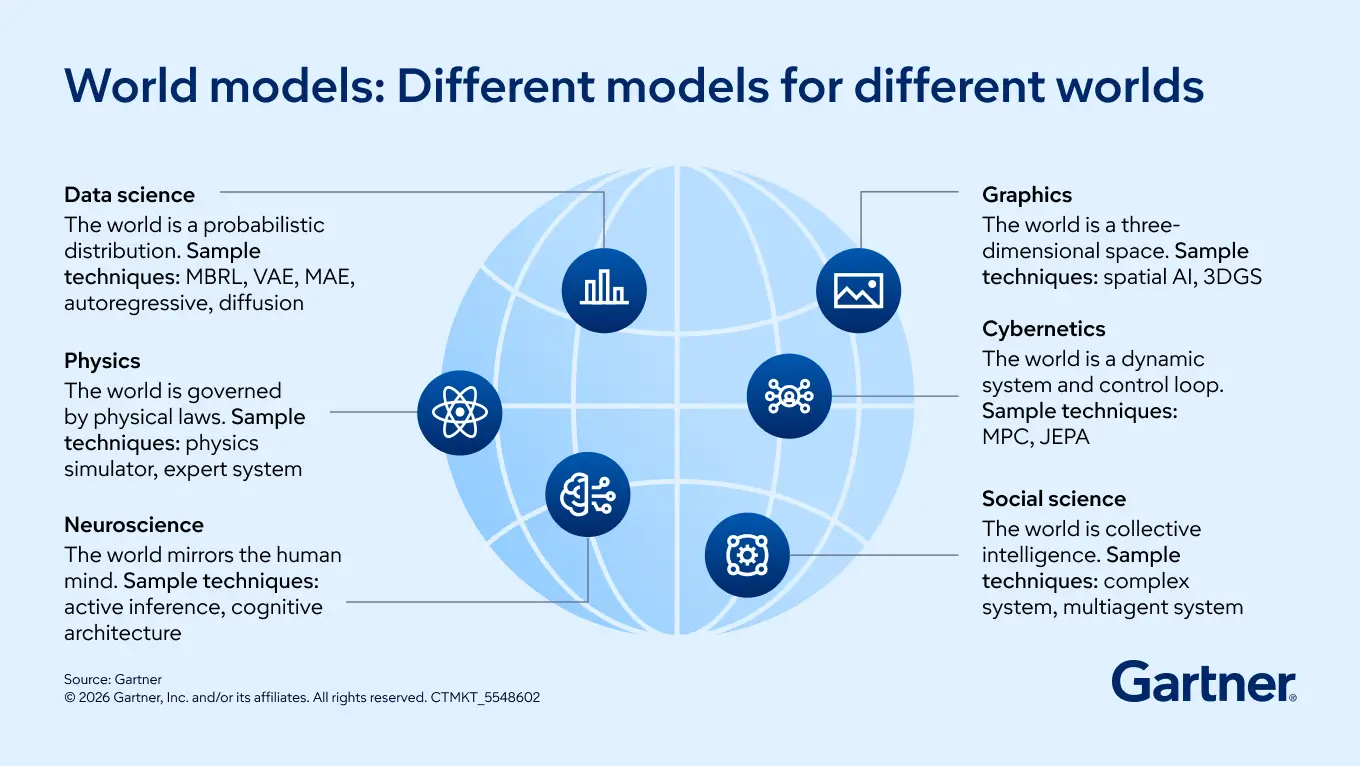
Generative AI has transformed how organizations create content and automate work. But world models, one of the Gartner Top Strategic Technology Trends for 2027, points to a different source of future advantage: The ability to predict outcomes before acting. World models learn representations of real-world environments and simulate potential future states, helping organizations evaluate decisions, test alternatives and navigate uncertainty with greater confidence.
The shift is significant because today’s AI systems primarily generate responses, while world models are designed to anticipate consequences. “World models imagine the unseen, making the invisible world visible,” says Ethan Cai, Principal Analyst at Gartner.
Organizations that fail to operationalize world models in the next three to six years could become slower to respond to change, miss opportunities or inflection points and make decisions with less confidence than competitors as business environments grow increasingly volatile.
You might also like this webinar: The Gartner Top Strategic Technology Trends for 2027
How leaders can prepare for a prediction-driven future
World models remain an emerging technology, but their potential impact on decision making, automation and business resilience is already becoming clear. Organizations should understand both where these models are likely to create value and the challenges that could slow adoption.
World models could reshape how industries operate
Although still in early stages, world models are delivering their most immediate impact in areas such as robotics, autonomous systems, digital twins, intelligent simulation, gaming and media production. As the technology matures, they are expected to drive innovation and efficiency across enterprise functions by helping organizations simulate complex interactions, predict outcomes and evaluate decisions before taking action. As embedded causal physics, longer-term memory and fleet learning are introduced between 2027 and 2030, capabilities will evolve rapidly. At the same time, training costs are predicted to drop 10 times within three years, making deployment economically viable.
The effects could be especially significant for industries that rely on physical systems and dynamic environments. In manufacturing and supply chains, world models can simulate production operations, optimize processes and test different operating scenarios. In healthcare, high-fidelity simulations can support training, improve clinical decision making and help evaluate treatment outcomes. Across industries, the common benefit is the same: Enabling leaders to test, learn and optimize in virtual environments before making decisions in the real world.
Significant hurdles remain before adoption scales
Despite their promise, world models are still in the early stages of maturity. Organizations must navigate a fragmented technology landscape that includes competing architectures, evolving business models and limited industry consensus around how the technology will develop.
Technical limitations also remain. Simulating complex environments, accurately inferring causal relationships and reproducing real-world physics with high fidelity continue to challenge current systems. High computational costs further restrict adoption. At the same time, many current world models remain focused on narrow use cases and lack the stability, adaptability and validation mechanisms required for high-stakes operational decisions. These challenges will not prevent adoption, but they reinforce the need for a deliberate and long-term approach.
What leaders can do now to gain a competitive edge
World models may not be ready for widespread deployment, but organizations can begin preparing for their impact today. Leaders should take these three immediate actions:
- Plan a five-year roadmap. Map a clear path to invest in and operationalize world models to capture predictive foresight as capabilities mature and deployment costs decline.
- Prepare multimodal data pipelines. Integrate multimodal model capabilities and synthetic data generation, including physics solvers, into end-to-end data pipelines to support future agentic workflows and real-time multisensory reasoning.
- Prove business value early. Demonstrate concrete productivity improvements, cost savings and safety benefits to stakeholders. Early wins can help build trust in autonomous agentic workflows, decision support and process optimization.
World models FAQs
What are world models?
World models are computational representations of real-world environments. Trained on massive multimodal datasets, they anticipate future states and make predictions that support decision making, intelligent automation and scenario testing.
Why are world models a top strategic technology trend for 2027?
World models represent a shift from AI systems focused primarily on generating content to systems designed to predict outcomes, simulate future scenarios and support more confident decision making. Gartner identifies them as a foundational technology for intelligent automation and physical AI applications.
How should leaders prepare for world models?
Leaders should plan a five-year roadmap, prepare multimodal data pipelines and prove business value through experimentation. Taking these actions now is recommended to build the capabilities needed as world models mature.
Attend a Conference
Experience CIO and IT Executive conferences
With exclusive insights from Gartner analysts on the latest trends, sessions curated for your role and unmatched peer networking, Gartner conferences help you accelerate your priorities.
22 – 23 Feb 2027
Gartner CIO Leadership Forum
Phoenix, AZ

Drive stronger performance on your mission-critical priorities.