Fund optionality before disruption occurs because proactive resilience now depends on sovereignty trade-offs and prepared alternatives.
- Gartner client? Log in for personalized search results.
Globalization assumptions no longer hold
The days of operating on the belief that open markets, global diversification and increasingly integrated operations would naturally create resilience are over. We are now experiencing a “trust recession,” where declining trust between nations, institutions, ecosystems and markets is reshaping how global business operates. According to Gartner, 94% of leaders anticipate major changes stemming from geopolitical shifts and emerging digital sovereignty laws.
What makes this shift significant is that volatility is no longer an occasional disruption, but a permanent operating condition. “Your old playbook of pure global efficiency is now a fatal liability,” says Vice President Analyst Suzie Petrusic, “Abandon the pursuit of hyperintegration and design your enterprise explicitly for survivability.”
You might also like this webinar: Manage Geopolitical Risks and Digital Sovereignty in a Fast-Moving Government Environment
How to redesign for survivability in a volatile world
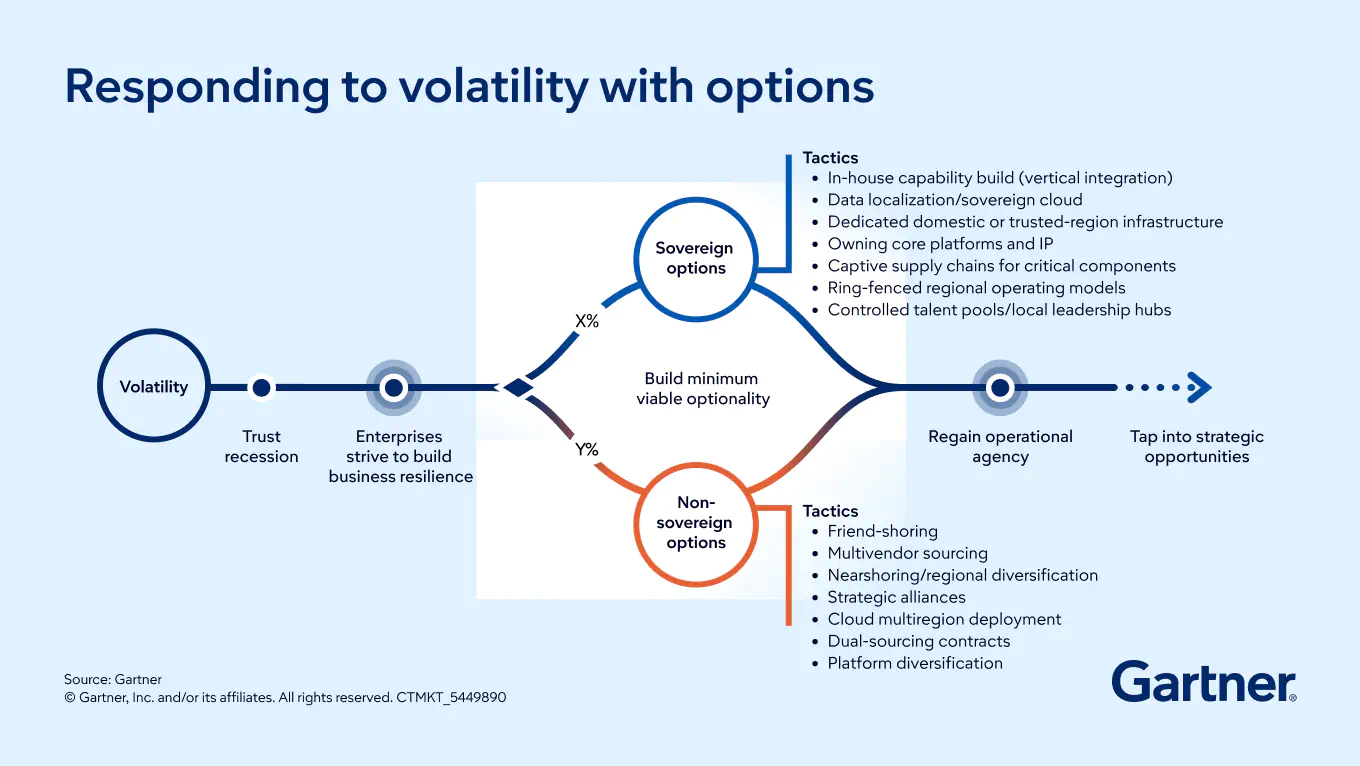
The challenge is not simply managing more risk. It is deciding where sovereignty matters, funding optionality and redesigning the organization for a world where continuity can no longer depend on assumed stability.
Fund optionality before a crisis exposes the gaps
Maintaining resilience now requires deliberate investment. Organizations cannot be sovereign everywhere and optionality is expensive. Many organizations conduct scenario planning, but those exercises have limited value unless leaders fund the ability to act on them. Waiting until a disruption occurs is no longer a viable strategy. Instead, take these steps:
Rather than spreading investments across every possible vulnerability, identify the critical enterprise value and operations you must protect, and fund backup solutions in those areas.
Allocate preapproved contingency capital and define a minimum viable business that must remain operational during a crisis.
Hidden dependencies become strategic vulnerabilities
The “trust recession” exposes a problem many organizations have overlooked. While they may understand their direct suppliers, they often lack visibility into deeper dependencies across technology, infrastructure and supply chains. Prepare for volatility with the following actions:
Identify the most important dependencies and make a deliberate decision to keep, diversify or control each one to ensure immediate switchability.
Break single-source dependencies, localize operations where appropriate and conduct live switch-over drills. If a critical region, supplier or technology becomes unavailable, alternatives should already be operational.
Accept the trade-off between efficiency and continuity
According to Gartner, 70% of C-suite members say geopolitical and economic volatility has damaged their industry during the past 12 months. A response is already underway. Gartner reports that 82% of technology executives have made at least three off-cycle strategic pivots in 2025 related to resiliency, adaptability or vendor partnerships. More than half of companies are actively executing on their supply chain redesign. In order to absorb volatility, take these steps:
Stop optimizing critical systems purely for cost. Organizations may need to fund sovereign alternatives, maintain backup capabilities or support regional operations that appear less efficient on paper.
Rearchitect your AI products around model optionality by defining primary, fallback, restricted and sovereign routes for every critical feature.
Organizations that make these trade-offs intentionally gain operational agency. Those that delay may find themselves forced into costly reactive measures when disruption occurs or worse — denied access to their critical markets. In a world defined by persistent volatility, survivability becomes a strategic advantage.
Trust recession FAQs
What is the trust recession?
According to Gartner, the trust recession describes a period in which declining trust between nations, institutions, ecosystems and markets is reshaping global business. As a result, enterprises face increasing geopolitical fragmentation, regulatory divergence and sovereignty requirements.
Why does the trust recession change resilience planning?
Gartner argues that volatility is no longer an episodic disruption but a permanent operating condition. Organizations can no longer assume stable market access, regulatory consistency or uninterrupted global operations. Resilience now depends on funded optionality and the ability to pivot when conditions change.
How should leaders respond to the trust recession?
Gartner recommends building minimum viable optionality through a strategic mix of sovereign and nonsovereign solutions, funding contingency capabilities before they are needed, reducing critical dependencies, testing switch-over plans and prioritizing continuity over pure efficiency in critical operations.
Attend a Conference
Accelerate growth with Gartner conferences
Gain exclusive insights on the latest trends, receive one-on-one guidance from a Gartner analyst, network with a community of your peers and leave ready to tackle your mission-critical priorities.

Drive stronger performance on your mission-critical priorities.