Orlando, Fla., October 29, 2024
- Gartner client? Log in for personalized search results.
Gartner ReimagineHR Conference, North America: Day 2 Highlights
It’s not too late to join the conference
Overview
We are bringing you news and highlights from the Gartner ReimagineHR Conference taking place through tomorrow, Wednesday, October 30, in Orlando, Florida. Below is a collection of the key announcements and insights coming out of the conference. You can read the highlights from Day 1 here.
On Day 2 from the conference, we are highlighting the latest HR technology trends, talent management in a resource-constrained world, proactive risk management for DEI, and measuring the quality of a new hire.
Be sure to check this page throughout the day for updates.
Key Announcements
- Gartner Opening Keynote: Gartner HR Research Finds Organizations Are in the Midst of a Reset; Most Are Not Prepared
- HR Leaders Should Evaluate Three Foundational Building Blocks Before Implementing AI in Performance Management
- Gartner Survey Shows 85% of Business Leaders Agree There Will Be a Surge in Skills Development Needs Due to AI and Digital Trends in Next 3 Years
2025 HR Technology Imperatives: Get Grounded on the Latest HR Technology Trends
Presented by Anand Chouksey, Senior Director Analyst, Gartner
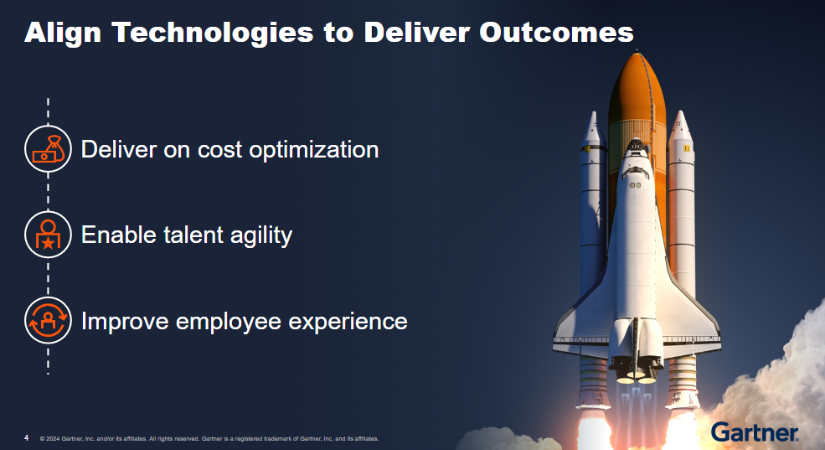
When evaluating and developing their technology strategy, HR leaders must ensure they are up-to-date on the latest trends. In this session, Anand Chouksey, Senior Director Analyst, Gartner, shared how HR technology can help deliver on outcomes and the key imperatives to keep in mind when developing a 2025 HR Technology strategy.


Key Takeaways
“To deliver on outcomes, HR leaders need to align their HR technology strategy to three main outcomes: cost optimization, talent agility and employee experience.”
“Cost Optimization: Supporting cost optimization is among the top three strategic priorities for HR technology transformation.
Organizations should focus on hyperautomation, which will enable them to achieve efficiency by streamlining their existing HR technology portfolio, including automating tasks, optimizing resources and accelerating processes.”
“Talent Agility: To succeed today, organizations must be able to quickly adapt and respond to changes – in the market, technology, and workforce dynamics – by ensuring that the right people with the right skills are in the right roles at the right time.”
“Employee Experience: Employees expect HR technology tools and technologies to enable them to perform their work efficiently with consumer grade experience.
HR can improve adoption and overall employee sentiment around HR technology by focusing on three key components of employee experience: understanding personas, journeys and connected moments.”
Journalists can receive additional information and/or request an interview with the Gartner expert by contacting Mary Baker at mary.baker@gartner.com or Gerri Weinberger at gerri.weinberger@gartner.com.
Overcome the Overwhelm: Managing Talent Management in a Resource Constrained World
Presented by Kamil Donaldson, Senior Principal, Advisory, Gartner
The wide breadth of scope, urgency of initiatives, and constant change faced by talent management leaders often leaves them and their teams stretched too thin. In this session, Kamil Donaldson, Senior Principal, Advisory, Gartner, offered two tactical strategies HR leaders can use to manage and deliver talent management effectively in a resource-constrained environment.


Key Takeaways
“Talent management leaders are planning more than they can actually execute in a year; on average there are 16 major annual talent management initiatives planned, yet out of total HR staff, only 7% are allocated to talent management.”
“Fifty-nine percent of HR leaders agree that focusing on too many priorities has made it more difficult for the function to be effective over the last three years.”
“Going forward, talent management leaders must focus on fewer priorities to achieve greater results.”
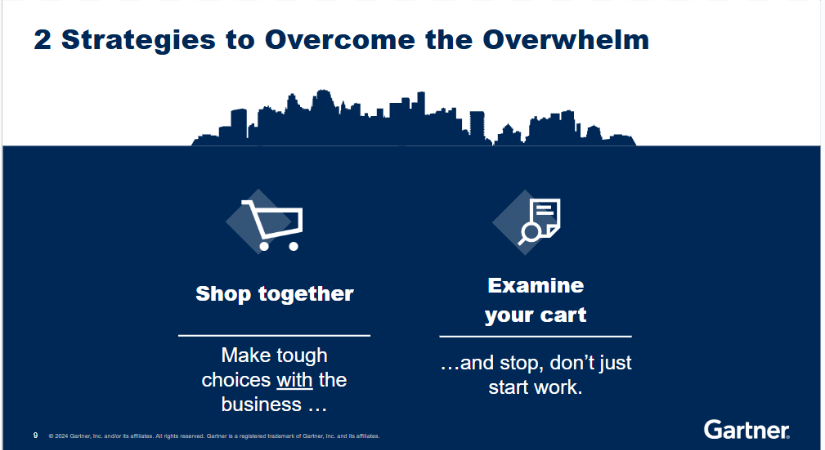
“There are two strategies talent management leaders can employ to re-prioritize what they focus on:
Make tough choices with the business: Collaborating with business leaders is crucial to help them clarify their real needs to ensure efforts are aligned between HR and the business.
Stop, don’t just start work: Review workstreams to ensure that time and resources are spent on the work that really makes a difference.”
Journalists can receive additional information and/or request an interview with the Gartner expert by contacting Mary Baker at mary.baker@gartner.com or Gerri Weinberger at gerri.weinberger@gartner.com.
Reaction to Foresight: Proactive Risk Management for Continued DEI Progress
Presented by Ivan W. Hall, Sr. Principal, Advisory, Gartner
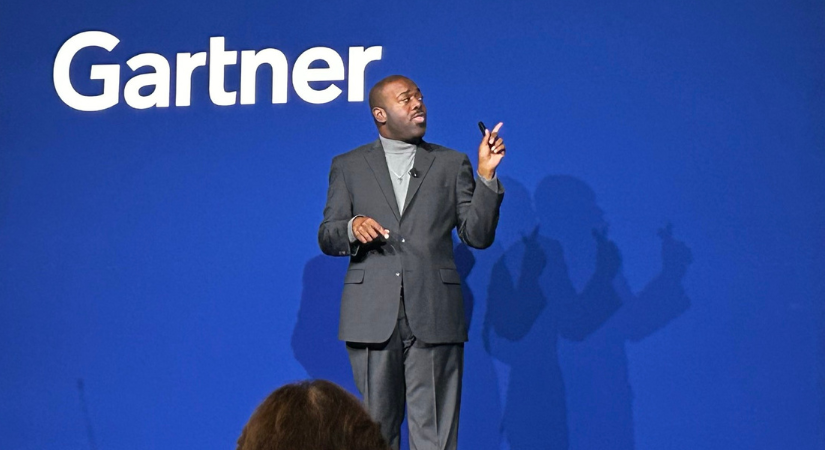
With political and societal challenges to DEI initiatives becoming increasingly prevalent, many DEI leaders find their programs facing instability. In this session, Ivan W. Hall, Sr. Principal, Advisory Gartner, explored how to anticipate and navigate potential risks, strategically plan responses, and build trust with key stakeholders.

Key Takeaways
“Most organizations are not prepared to address today’s divisive DEI landscape; only 4% of DEI leaders believe risk management is a crucial skill.”
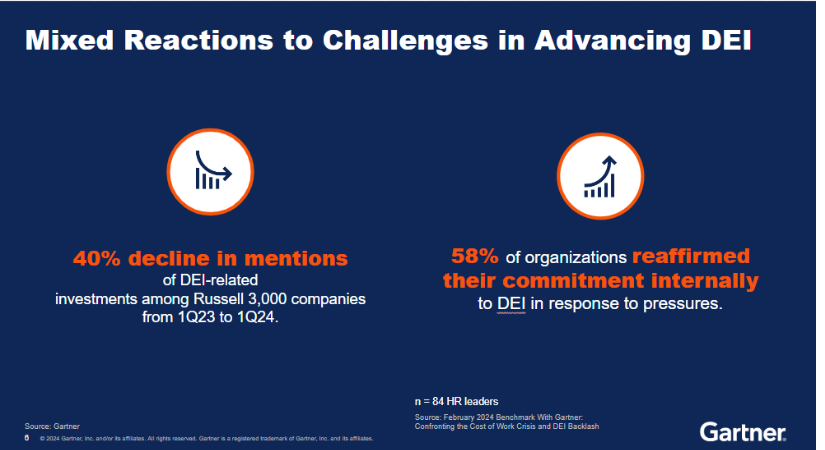
“There is currently a dissonance as many companies are adopting a quieter DEI posture externally to avoid scrutiny while reaffirming their commitment to DEI internally.”
“A reactive approach can have unintended consequences. Instead organizations should shift from reaction to foresight.”
“There are four actions leaders can take to manage risk and ensure continued DEI progress:
Build a risk-sensing network to identify and address risks to DEI continuity
Evaluate and respond to risks based on likelihood and potential impact
Align DEI to business priorities to communicate value and DEI’s ability to influence business-critical metrics
Tailor communication to key decision makers based on their risk understanding and appetite”
Journalists can receive additional information and/or request an interview with the Gartner expert by contacting Mary Baker at mary.baker@gartner.com or Gerri Weinberger at gerri.weinberger@gartner.com.
The Recruiting Leader's Guide to Measuring Quality of Hire
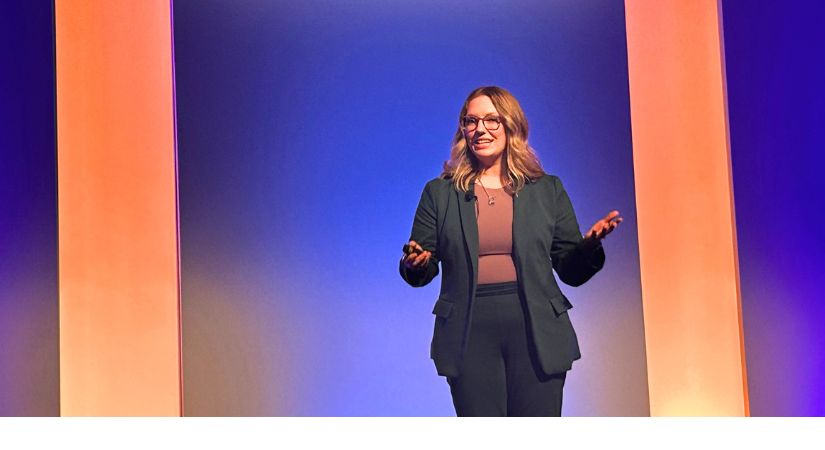
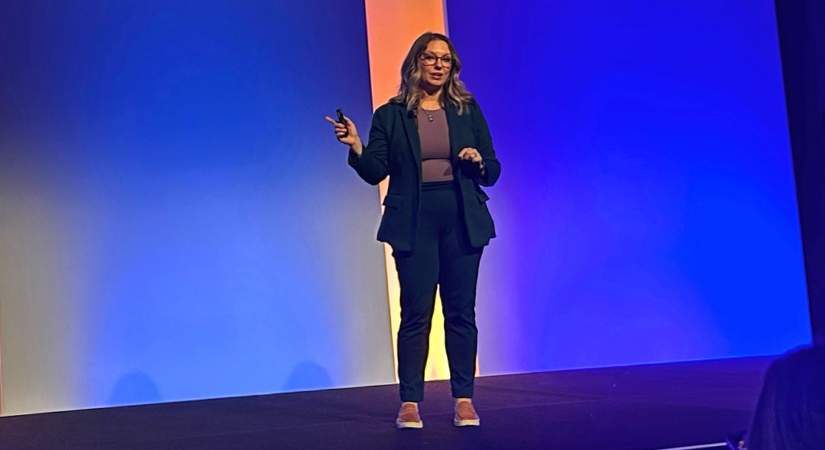
Presented by Jennifer Gaia, Director, Advisory, Gartner
Today, recruiting leaders have a mandate to attract and hire high-quality talent, but they often neglect quality of hire due to their lack of confidence in measuring it effectively. In this session, Jennifer Gaia, Director, Advisory, Gartner, provided a guide for recruiting leaders on how to define, measure, and drive quality of hire.

Key Takeaways
“Gartner research shows that only 28% of recruiting leaders are actually measuring quality of hire.”
“The recruiting leaders who are measuring quality of hire are struggling: 57% selected quality of hire in the top three metrics to improve and only 6% are confident in their ability to measure quality of hire.”
“There are three things recruiting leaders must do to reach their goal of measuring quality of hire:
Define quality of hire for the future: Consider common performance criteria and methodology for identifying high performers, and then identify leading indicators to measure, including individual performance (role), network performance (team) and contribution to the organization
Measure from diverse perspectives: Collect feedback from relevant peer groups to validate your assessment
Communicate for actionability: To influence change with business partners, recruiting leaders should consider the various inputs they collected earlier (role, team, organization) to create a quality of hire score that can be easily communicated and understood”
“To drive business value when communicating with stakeholders, recruiting leaders should leverage data to:
Explain not just what but why
Engage and validate their needs
Give clear recommendations tied to stakeholder value
Establish a call to action to foster support”
Journalists can receive additional information and/or request an interview with the Gartner expert by contacting Mary Baker at mary.baker@gartner.com or Gerri Weinberger at gerri.weinberger@gartner.com.

It’s not too late to join the conference
Thanks for following along!
Media contact
Mary Baker
Gartner
mary.baker@gartner.com
Gerri Weinberger
Gartner
gerri.weinberger@gartner.com


Latest releases
About Gartner
Gartner (NYSE: IT) delivers actionable, objective business and technology insights that drive smarter decisions and stronger performance on an organization’s mission-critical priorities. To learn more, visit gartner.com.