- Gartner client? Log in for personalized search results.
Gartner CFO & Finance Executive Conference: Day 2 Highlights
It’s not too late to join the conference
Overview
We are bringing you news and highlights from the Gartner CFO & Finance Executive Conference, taking place this week in National Harbor. Below is a collection of key announcements and insights coming out of the conference. You can read the highlights from Day 1 here.
On Day 2 of the conference we are highlighting sessions covering the roles and career paths in a digital controllership function, how to create long term value with strategic cost optimization, and implementing data governance that enables AI.
Key Announcements
New Roles and Career Paths for a More Digital Controller Function
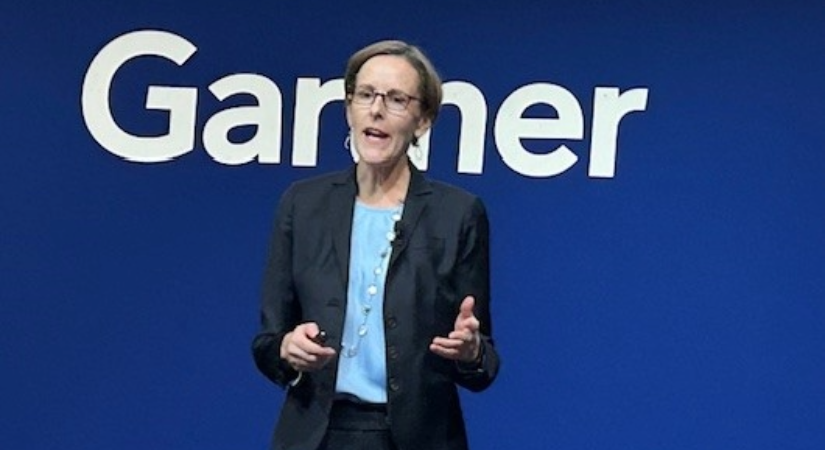
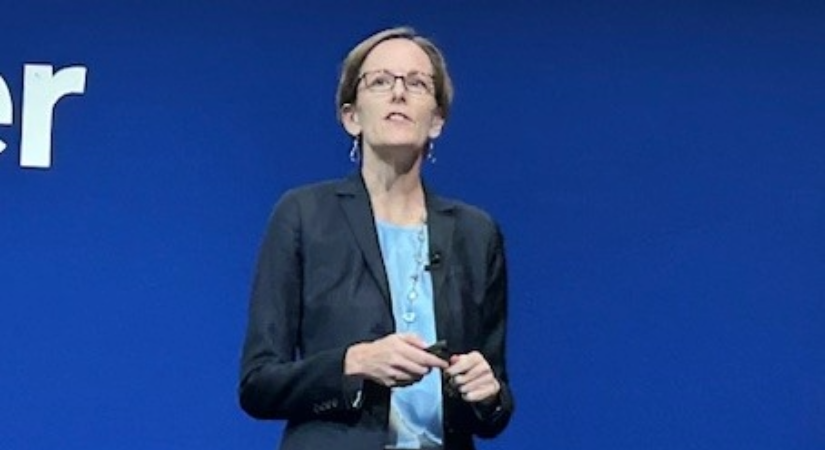
Presented by Hilary Richards, Vice President Analyst at Gartner
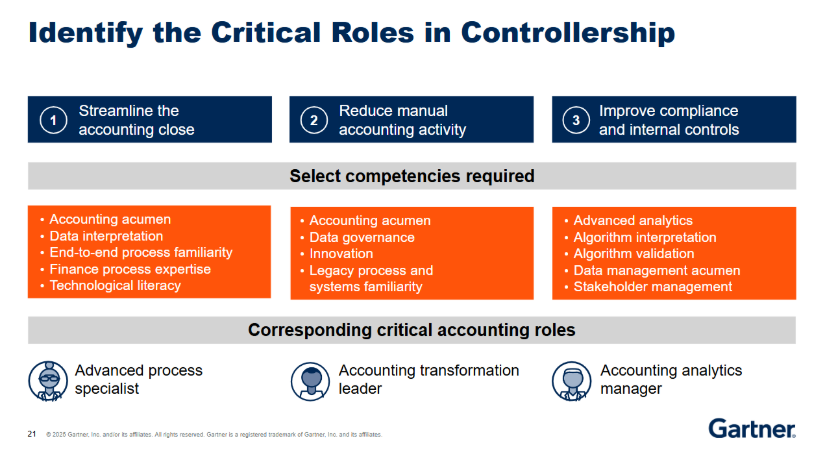
The widespread adoption of automation and AI requires a new breed of digital accountant. In this session, Hilary Richards, Vice President Analyst at Gartner, covered how the accounting role has, and will, continue to evolve in a digital controllership.
Key Takeaways
Legacy accounting roles are expected to fall from 68% in 2023 to 42% in 2028, while the numbers of technology experts and accountants with technology expertise are expected to double or more in the same period.
Controllers must identify the most relevant knowledge, skills and abilities their teams need, carefully consider what role(s) can be trained or developed in house, and what should be prioritized in hiring.
To close the gap between where the finance digital competencies are, and where they need to be, identify digital competencies that are adjacent to those with which accountants are already familiar. Leaders should also foster digitally literate accountants and advanced technology users step-by-step.
Journalists can receive additional information and/or request an interview with the Gartner expert by contacting Rob van der Meulen at rob.vandermeulen@gartner.com
How to Create Long-Term Value with Strategic Cost Optimization
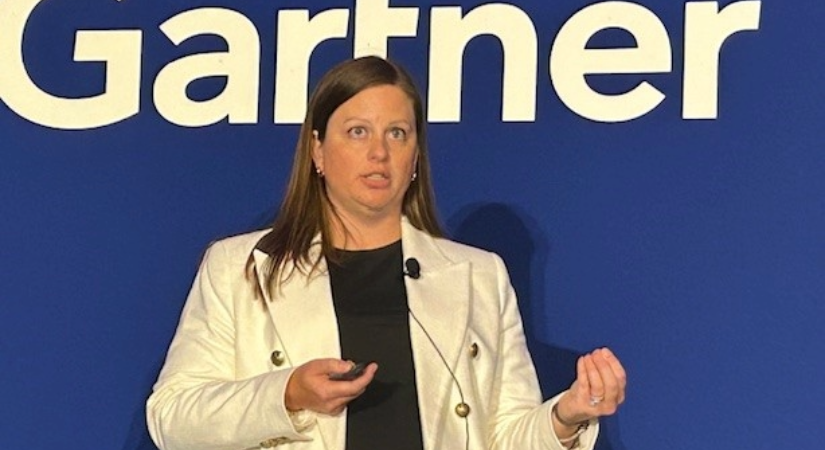
Presented by Michelle Carlsen, Director Analyst at Gartner
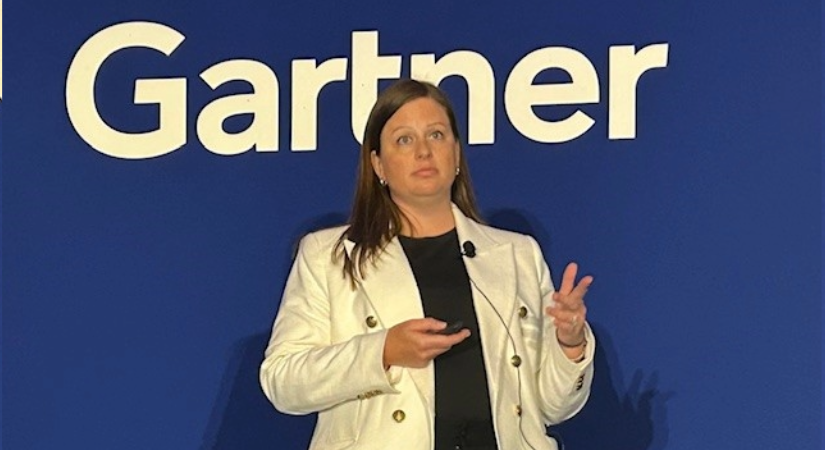
Eighty–three percent of CFOs say they are looking for cost savings beyond budget baselines in 2025. In this session, Michelle Carlsen, Director Analyst at Gartner, shared a sustainable approach to cost optimization that can drive a six-point premium over peers in long–term value realization.
Key Takeaways
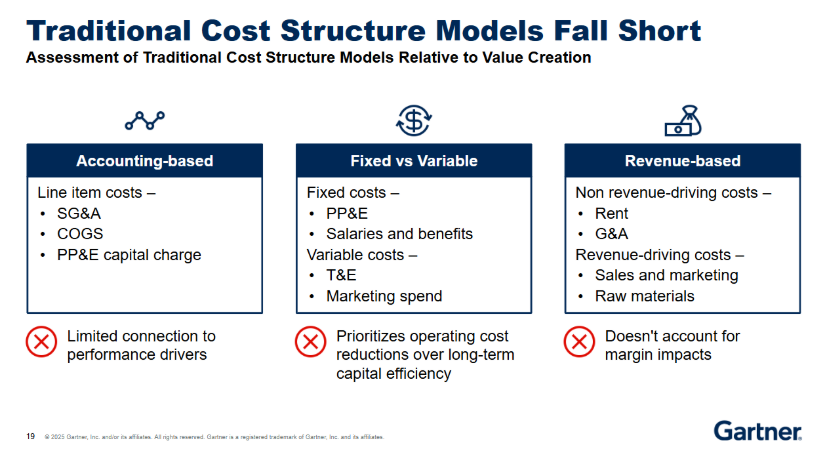
- CFOs are very focused on cost savings currently, but traditional cost structure models aren’t always the most effective to drive long term value creation. Sustained success is rare with just 11% of organizations able to keep their efforts going into a third year.
The long-term value creation of cost optimization initiatives is greatly improved by focusing efforts in a way that prioritizes and protects spending towards factors intrinsic to the organization.
Cost optimization and efficiency improvement strategies should be used for enabling costs. Enabling costs directly support mission-critical operational outcomes, and the optimization goal in this area should be to achieve a satisfactory level of performance with the minimum viable spend.
The bulk of cost cutting should be aimed towards commoditizing costs. Commoditizing costs are those that any competitor can incur. The goal here should always be to minimize spend to as little as possible because any spend here creates no market differentiation for an organization.
Journalists can receive additional information and/or request an interview with the Gartner expert by contacting Rob van der Meulen at rob.vandermeulen@gartner.com
A Practical Approach to Implementing Data Governance That Enables AI
Presented by Clement Christensen, Senior Director Analyst at Gartner
Using an approach that connects data investments to business outcomes, business leaders can approach data governance as a local issue and deliver well-organized, accessible, observable, and relevant data. In this session, Clement Christensen, Senior Director Analyst at Gartner, shared how to put effective governance and data management practices in place to prepare data for AI.


Key Takeaways
- For AI data governance projects to succeed, data management and governance are being prioritized with many organizations now recognizing that if they don’t invest in their data, their investments in AI fail.
AI-ready data has three characteristics: it must be accessible and well organized, users must be able observe the data to understand and monitor the health and quality of the data, and users need to be able to understand if the data is relevant to the use-case.
Data governance for AI needs to be both adaptive and federated.
Adaptive governance is the practice of determining data governance rules in relation to how data is used (i.e., governed by use case).
Federated governance is a hybrid model of ownership for data governance rules, policies and definitions, where ownership is divided between corporate and business entities.
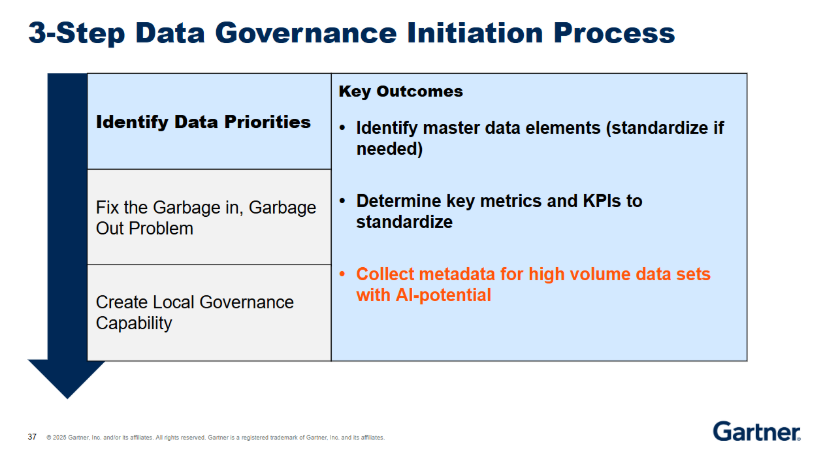
When initiating data governance, identify the data priorities and work to understand where to drive active metadata management, where it is treated and analyzed just like data.
Journalists can receive additional information and/or request an interview with the Gartner expert by contacting Rob van der Meulen at rob.vandermeulen@gartner.com

It’s not too late to join the conference


About Gartner
Gartner (NYSE: IT) delivers actionable, objective business and technology insights that drive smarter decisions and stronger performance on an organization’s mission-critical priorities. To learn more, visit gartner.com.