Fresh insights on emerging trends
- Gartner client? Log in for personalized search results.
Gartner First Takes

Preview
First Take: The U.S. Kill Switch Act Demands Vendor-Agnostic Agentic AI
By Andrei Razvan Sachelarescu and Philip Allega | 24 July 2026
Heads of enterprise architecture (EA) must prepare for sudden operational disruptions to unhedged agentic AI systems as U.S. lawmakers propose an AI “kill switch” to shut down tools they believe threaten the public. Enforce a “don’t-trust-the-vendor” architecture to ensure that business processes do not collapse if a vendor is forced offline.
Analysis
How the New “Kill Switch” Act Demands a New Approach to Agentic AI System Architecture
On 23 July 2026, U.S. lawmakers introduced a bipartisan “AI Kill Switch Act” to give the U.S. federal government explicit authority to throttle or shut down AI models.1 The bipartisan AI Kill Switch Act, introduced in the U.S. House of Representatives by Congressman Ted Lieu (D-CA) and Rep. Nathaniel Moran (R-TX), requires major AI developers to maintain shutdown capabilities and grants federal emergency intervention powers.
The head of EA must guide their organization toward architectural choices today that preserve strategic optionality tomorrow. Given the high probability of third-party model disruptions, organizations must build the runway now to engineer vendor-agnostic control before a vendor collapse halts the business. This provides the hedge against this probable future.
Treating vendor model availability as a given is insufficient. Doing so is a critical architecture failure. Heads of EA must enforce a “don’t-trust-the-vendor” mindset for all agentic AI systems.
Implications
Hard-coded APIs guarantee abrupt service collapses: If the U.S. Department of Homeland Security (DHS) orders OpenAI or Anthropic, for example, to pull a model offline or throttle its throughput due to a safety incident, your agentic AI solution instantly breaks. If your agentic AI system is directly hard-coded to that vendor’s API, you have zero control, zero uptime and zero ability to redirect the work.
Vendor lock-in halts your business processes: If a vendor is forced to modify a model’s capabilities, remove a tool or apply heavy rate limits to avoid federal penalties, your business process stops working. Without a local interception proxy, you cannot seamlessly swap “Model A” for “Model B” or fall back to an open-source model running on your own servers.
Unhedged AI creates massive contractual and audit exposure: If your enterprise sells software or services to its own clients, those clients, or possibly your business insurance provider, will increasingly ask: “If your underlying AI provider gets shut down or goes rogue, do you have a way to stop it and keep our data/business safe?” If the answer is, “No, we just rely on the providing vendor’s safety guardrails,” then your enterprise assumes massive operational and contractual liability.
Action Steps
To mitigate the severe business, operational and continuity risks created when vendors drop endpoints or regulators force model shutdowns, you must execute three key actions ...
Already a Gartner client?
Gain full access to this First Take and more exclusive insights by becoming a Gartner client.
Related insights
First Takes are just a sliver of what Gartner clients get

Guidance on your mission-critical priorities (MCPs)
Focus on the core imperatives that drive results for your business, board and stakeholders with step-by-step plans, bold and actionable perspectives, comprehensive insights and answers to your biggest questions.

Tools to make decisions with confidence
Gartner Hype Cycle™, Gartner Magic Quadrant™ and Gartner Score are just a few tools you can use to assess current performance, implement best practices and accelerate improvements.

Access to C-Level Communities, conferences and peer networks
Connect with Gartner analysts, best-in-class solution providers and verified peers to refine your organization’s strategies, dial up growth, reduce risk and gain a competitive edge.
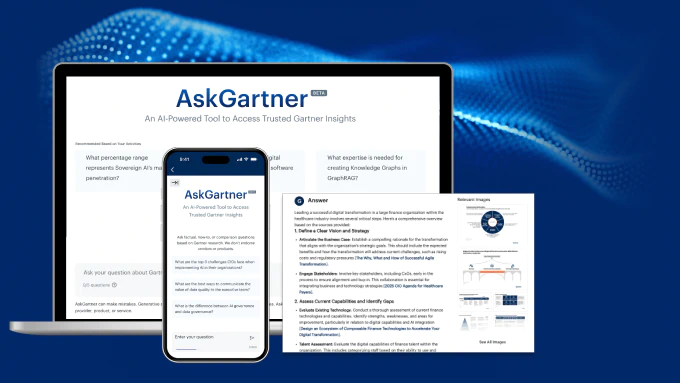
AskGartner
AskGartner is the only AI-powered tool that gives you access to the proprietary Gartner insights trusted by C-Level executives and their teams.
© 2026 Gartner, Inc. and/or its affiliates. All rights reserved. Gartner is a registered trademark of Gartner, Inc. and its affiliates. This publication may not be reproduced or distributed in any form without Gartner's prior written permission. It consists of the opinions of Gartner's business and technology insights organization, which should not be construed as statements of fact. While the information contained in this publication has been obtained from sources believed to be reliable, Gartner disclaims all warranties as to the accuracy, completeness or adequacy of such information. Although Gartner business and technology insights may address legal and financial issues, Gartner does not provide legal or investment advice and its insights should not be construed or used as such. Your access and use of this publication are governed by Gartner’s Usage Policy. Gartner prides itself on its reputation for independence and objectivity. Its insights are produced independently by its business and technology insights organization without input or influence from any third party. For further information, see Guiding Principles on Independence and Objectivity. Gartner publications and other content may not be used as input into or for the training or development of generative artificial intelligence, machine learning, algorithms, software or related technologies.