AI-native operating models embed AI into infrastructure, workflows and governance rather than layering it onto legacy operations.
- Gartner client? Log in for personalized search results.
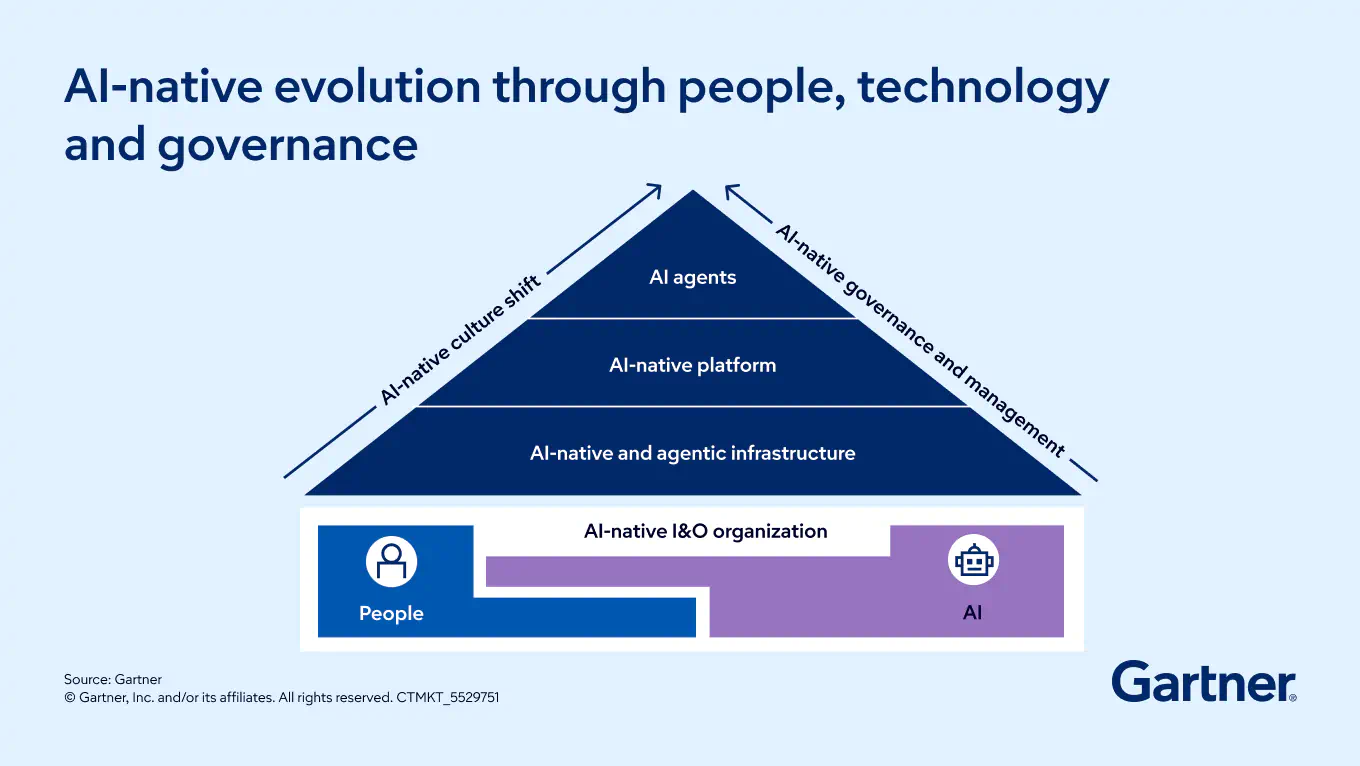
Traditional I&O models are reaching their limits
Enterprise AI adoption is creating new demands for infrastructure and operations (I&O) teams. As organizations expand their use of AI, I&O must support AI-native infrastructure, AI-native platforms and agentic capabilities across cloud, edge and hybrid environments. Traditional operating models focused on stability and risk mitigation are increasingly unable to meet the speed, scale and complexity required by enterprise AI initiatives.
The shift is not simply technological. AI-native approaches reshape infrastructure management, incident response, governance models and workforce responsibilities. Gartner predicts that by 2030, 80% of successful I&O AI transformations in China will come from enterprises adopting AI-native approaches and AI-first cultures to support business transformation.
“AI-native I&O organization is not about replacing traditional teams and professionals with AI. It is about enabling all I&O personnel to adopt AI-augmented operations by embedding AI into daily operation and management works, reskilling the workforce, modernizing governance and rewarding automation-led business outcomes,” says Carolin Zhou, Vice President Analyst at Gartner.
You might also like this webinar: The Future of Cloud in 2030: AI-Enabling Cloud Services
What leaders must change to achieve I&O AI transformation
Successful I&O AI transformation requires organizations to rethink culture, operating models and governance together. Focusing on technology alone will not deliver the full value of AI-native operations.
Culture must evolve before operations can
Many I&O organizations have historically prioritized predictability and risk avoidance. These behaviors can slow AI adoption unless teams are encouraged to experiment and innovate responsibly.
To create an AI-native culture, leaders should embed AI into daily operations, establish psychological safety and support experimentation that improves digital productivity and infrastructure resilience. Leaders should reposition I&O as an AI business enabler rather than a function focused solely on uptime, ticket management and infrastructure costs.
Workforce development is equally important as AI literacy and technical capability gaps are major barriers to transformation. Role-based training and continuous learning programs can help operational engineers, platform architects and service managers adopt AI-augmented ways of working.
Roles and organizational structures must be redesigned
AI-native organizations require more than process improvements. They require structural change.
By 2030, Gartner expects fewer than 20% of I&O roles to disappear completely, while more than half will be fundamentally redesigned around AI-native platforms, AI infrastructure, automation and AI governance. This represents a significant increase from less than 5% of roles in 2026.
As AI capabilities expand, organizations should assess where agentic AI can safely augment repetitive and standardized work. Opportunities in areas such as event correlation, incident triage, configuration validation, routine provisioning, capacity analysis and automated remediation within defined guardrails.
The transition also encourages movement from functional silos toward more cross-functional teams with responsibilities that span AI operations, governance and platform management.
Governance becomes a competitive requirement
Many AI initiatives focus too heavily on model capabilities while overlooking foundational governance requirements.
Effective AI-native governance includes clear accountability, defined policies, human oversight and risk controls. Organizations should establish governance structures that bring together stakeholders from security, compliance, legal, business and AI disciplines. Responsibilities should be clearly defined across the AI life cycle.
Heads of I&O should extend governance beyond AI models to cover the full AI technology stack, including infrastructure, platforms, agents, data, APIs and operational processes. High-risk activities should remain subject to human approval and policy-based controls.
This balance between autonomy and oversight enables organizations to benefit from AI-driven operations while maintaining compliance, resilience and operational control.
I&O AI transformation FAQs
What is I&O AI transformation?
I&O AI transformation is the evolution of infrastructure and operations into an AI-native organization. This involves embedding AI into infrastructure, platforms, workflows and governance rather than adding AI tools onto existing environments.
Why is an AI-native approach important for I&O AI transformation?
Traditional I&O operating models cannot adequately support the pace, scale and complexity of enterprise AI adoption. AI-native approaches help organizations improve agility, accelerate decision making and create continuous learning and operational improvement.
How does governance support I&O AI transformation?
I&O leaders should establish governance that defines roles, accountability, acceptable use policies, oversight requirements and risk controls. Governance should extend across models, agents, infrastructure, data and operational processes while maintaining human oversight for high-risk activities.
Attend a Conference
Join Gartner analysts and your peers to accelerate growth
Gather alongside I&O leaders in Las Vegas to gain insight on emerging trends, receive one-on-one guidance from Gartner experts and create a strategy to tackle your priorities head-on.
8 – 10 Dec 2026
Gartner IT Infrastructure, Operations & Cloud Strategies Conference
Las Vegas, NV

Drive stronger performance on your mission-critical priorities.