To fully leverage AI agents, I&O may need to rethink how work is organized.
- Gartner client? Log in for personalized search results.
The productivity mindset is too small
Many heads of infrastructure and operations are investing in agentic AI to help address persistent skills shortages and resource constraints. Most organizations are focused on making existing teams faster and more efficient with AI agents. Yet efficiency gains alone have limits.
“Organizations are approaching a point where humans assisted with AI tools will operate slower and with less efficiency than humans managing agentic AI,” notes Jonathan Forest, Vice President Analyst at Gartner. As AI agents take on more reasoning, planning and execution, the bigger challenge becomes rethinking operating models that were built for human execution. Instead of simply helping people do the work, AI agents are changing how the work gets done and who does it.
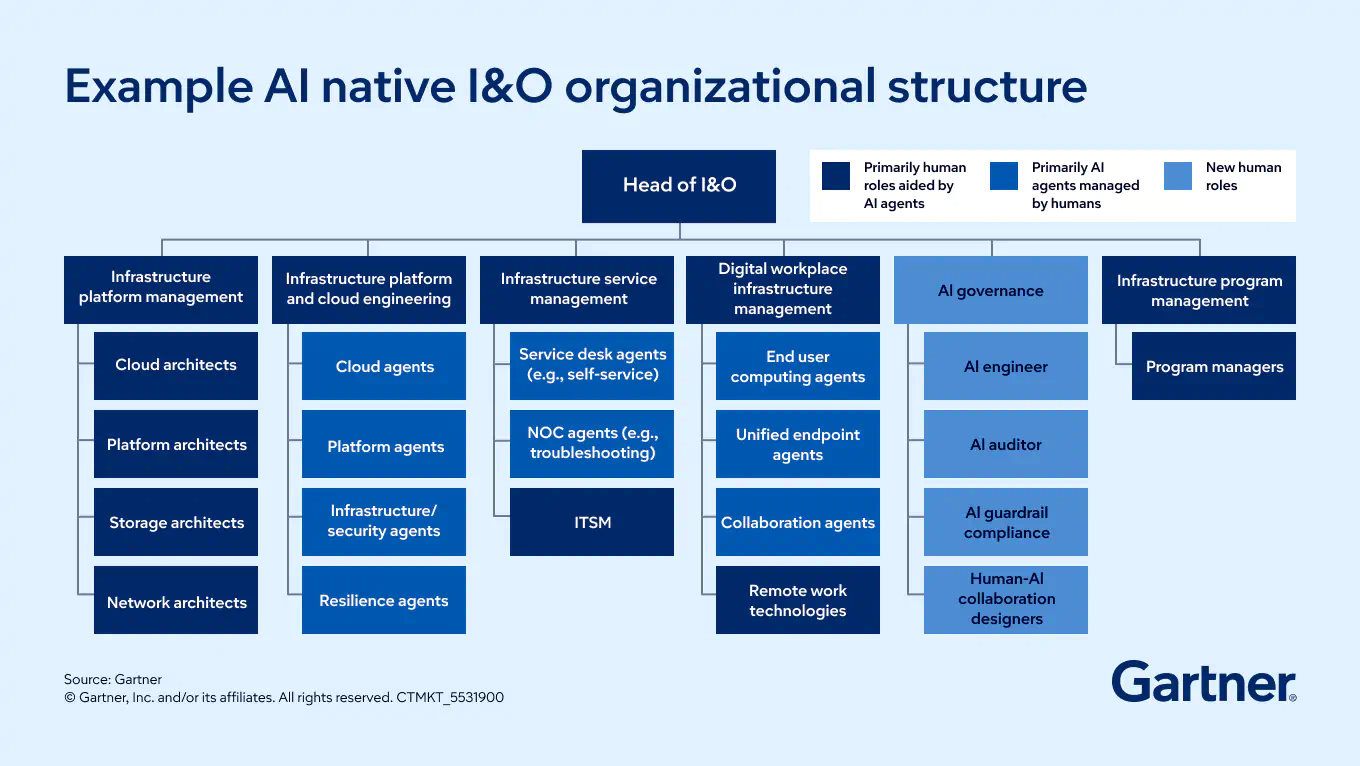
That shift has significant implications for I&O organizations. According to Gartner, by 2030, 50% of I&O organizations will be restructured as heads of I&O invest in AI agents to accomplish complex I&O management tasks. Gartner also estimates that more than 90% of I&O organizations are not prepared for this level of organizational redesign.
You might also like this webinar: 2026 Technology Adoption Roadmap for Infrastructure and Operations
Rethinking the role of people in an AI-centric organization
The long-term opportunity is not simply automating tasks with existing processes. It’s redesigning how work is executed, organized, governed and measured when AI agents become active participants in I&O operations.
People move from execution to oversight
Traditional I&O organizations rely on people to execute work, investigate issues and make operational decisions. As agentic AI becomes more embedded, human responsibilities shift toward governance and supervision.
Future roles emphasize validating outputs, managing exceptions and overseeing AI-driven processes. Skills also evolve. Technical specialists who focus on individual technologies increasingly move toward broader responsibilities that span systems, processes and AI agents. Instead of responding to outages, teams spend more time preventing them. Instead of performing investigations, they validate recommendations and outcomes. Humans remain accountable, but their contribution increasingly comes through judgment, oversight and governance rather than day-to-day execution.
Silos become a barrier to speed and scale
Many I&O teams still operate through separate functions such as networking, storage and infrastructure. While that model reflects how technology environments were traditionally managed, it can slow decision making and create dependencies between teams.
As AI agents take on more operational work, organizations can rely more heavily on cross-functional teams with end-to-end ownership. Fewer management layers, broader responsibilities and closer collaboration enable faster execution. The focus shifts from managing individual technology domains to managing services, platforms and outcomes. This also changes leadership priorities. Rather than optimizing individual teams, heads of I&O must determine where AI agents create the most value and where human oversight remains essential.
Success is measured by outcomes, not activity
Historically, many I&O organizations measured performance through outputs such as tickets resolved, incidents handled or systems maintained. That approach becomes less meaningful when AI agents can generate large volumes of operational output. Instead, attention shifts to business outcomes and service performance. Teams spend less time on manual activities and more time defining intent, designing systems and managing exceptions. The goal is no longer to maximize activity but to improve results.
Organizations that continue measuring effort may struggle to recognize the value created by agentic AI. Those that focus on outcomes are better positioned to capture the efficiency, agility and performance improvements that AI-centric operating models can provide.
Agentic AI in I&O FAQs
Why does agentic AI require organizational redesign?
Agentic AI changes how work is executed, governed and coordinated. Existing I&O structures were designed around human execution, while future environments increasingly rely on people supervising and governing AI agents.
How will I&O roles change with agentic AI?
Many roles will shift from execution-focused work toward oversight activities such as governance, validation and exception management. Skills will increasingly emphasize managing systems, processes and AI agents rather than individual technology components.
What happens if organizations keep their current I&O structure?
According to Gartner, organizations that fail to restructure around agentic AI risk higher costs, weaker operational agility, lower performance and the longer-term risk of irrelevance.
Attend a Conference
Experience CIO and IT Executive conferences
With exclusive insights from Gartner analysts on the latest trends, sessions curated for your role and unmatched peer networking, Gartner conferences help you accelerate your priorities.
22 – 23 Feb 2027
Gartner CIO Leadership Forum
Phoenix, AZ

Drive stronger performance on your mission-critical priorities.