Digital sovereignty is now a board-level priority. Here’s how I&O leaders can take control.
- Gartner client? Log in for personalized search results.
Digital sovereignty is now a strategic imperative for I&O
Digital sovereignty has quickly evolved into a core strategic focus for heads of I&O. You’re now expected to align infrastructure and operations with board-level priorities shaped by geopolitical and regulatory pressures. Failing to act exposes your organization to operational, financial and compliance risks — including direct financial losses and regulatory penalties.
I&O leaders must be proactive and reduce risks tied to digital sovereignty. As Carolin Zhou, Vice President Analyst at Gartner notes, “This means ensuring your data, infrastructure and technology are managed in line with local laws and regulations. Full visibility and control over cloud and AI platforms is no longer optional — it’s essential for operational independence and resilience.”
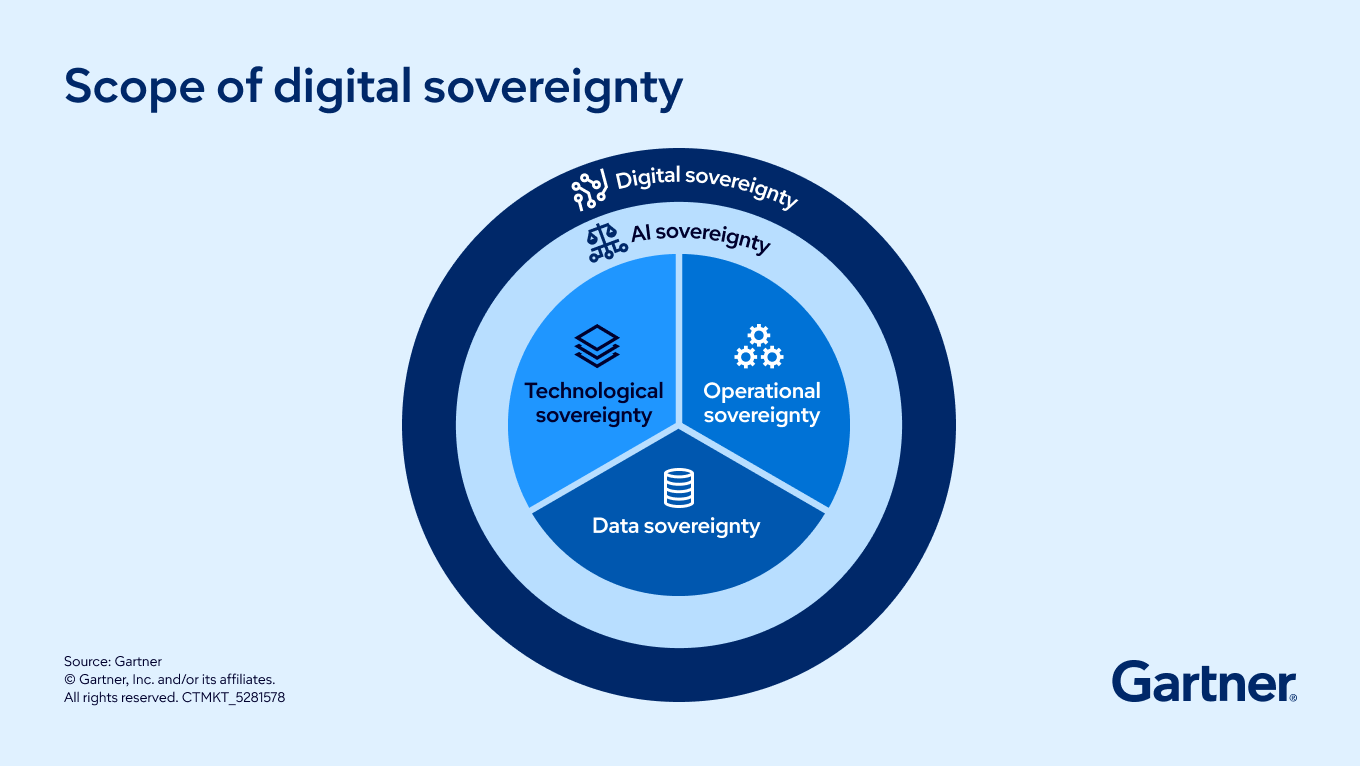
Digital sovereignty spans data, operations and technology
Digital sovereignty isn’t just a compliance exercise. Success comes down to gaining and maintaining control across three critical layers: data, operations and technology. Here’s how each dimension shapes your strategy.
Data sovereignty: Control data location and compliance.
Data sovereignty requires you to govern information under the legal and regulatory compliance frameworks of its country of origin. You must control where data is stored, processed and managed to guarantee compliance with local laws and regulatory requirements. Shifting mandates like the EU’s Cloud Sovereignty Framework now demand provable control over data flows. Use the data sovereignty spectrum to map regional requirements and build strategies that align with strict localization or moderate supervision, depending on your risk profile.
Operational sovereignty: Own infrastructure and access.
Operational sovereignty is about who operates and supports your IT systems — not just where data sits. You need to control provider operations, staff access and privileged credentials, especially in cloud and AI infrastructure. Regulations like NIS2, DORA and the U.S. Cloud Act require strict operational controls, including customer-managed encryption keys, local support personnel and robust incident reporting. Achieving this level of control can be costly and complex, so focus on critical workloads where the trade-offs are justified.
Technological sovereignty: Enhance IT resilience.
Technological sovereignty means developing, owning and managing essential digital technologies — hardware, software and AI systems — without undue reliance on foreign providers. Gartner data shows that 60% of enterprises cite increased security risks, 43% worry about loss of competitiveness and 31% face data residency uncertainty. For heads of I&O, autonomy over your technology stack is now a strategic imperative for resilience, innovation and compliance.
Choosing providers: Evaluate sovereignty features and risks.
When selecting cloud or AI providers, rigorously assess how each offering meets your unique sovereignty needs. Define criteria like data localization, feature parity of sovereign services, regulatory track record and jurisdictional boundaries. Look for providers with strong operational controls, a robust partner ecosystem and access to local talent. Balance the need for independence with operational excellence to achieve successful outcomes.
Take action and build a comprehensive digital sovereignty strategy
You can’t afford to treat digital sovereignty as a future issue. Start by mapping your regulatory environment and identifying critical data and workloads. Collaborate with legal, compliance and security teams to define operational access, support personnel location, key management and telemetry flow. Focus your sovereignty investments on high-risk or regulated workloads, and develop exit strategies to reduce dependency on external providers.
Rethink IT resilience and governance.
Redefine your operating model to support autonomy and resilience. Establish architecture governance that limits hidden dependencies on proprietary services. Regularly reassess vendor relationships and update your sovereignty playbook as regulations and risks evolve.
What’s next in data sovereignty?
I&O leaders must implement the necessary controls to ensure compliance, data privacy and technological sovereignty for cloud platforms supporting AI. This is a critical step in the mandate to transform cloud strategy for disruptive platform demands.
For government organizations, data residency, operational control and regulatory compliance are strategic priorities. Explore how public sector technology leaders are advancing digital sovereignty while enabling modernization and innovation.
Digital sovereignty FAQs
What is digital sovereignty and why does it matter for I&O leaders?
Digital sovereignty is your ability to control data, technology infrastructure and digital operations in line with local laws and regulations. It’s now a board-level priority, driven by regulatory pressures and geopolitical risks. For heads of I&O, digital sovereignty is essential for compliance, operational resilience and maintaining competitive advantage.
How can I&O leaders assess data sovereignty requirements?
Use the data sovereignty spectrum included above to map regional compliance thresholds and operational risks. Identify where strict data localization or moderate supervision applies, and build strategies that align with each region’s laws. This approach helps you avoid compliance failures and financial penalties.
What steps should I&O leaders take to achieve operational sovereignty?
Focus on controlling who operates and supports your critical systems. Implement customer-managed encryption keys, local support personnel and strict privileged access controls. Work with legal and compliance teams to ensure your operational model meets regulatory requirements and supports emergency data offload plans.
Attend a Conference
Experience CIO and IT Executive conferences
With exclusive insights from Gartner analysts on the latest trends, sessions curated for your role and unmatched peer networking, Gartner conferences help you accelerate your priorities.
22 – 23 Feb 2027
Gartner CIO Leadership Forum
Phoenix, AZ

Drive stronger performance on your mission-critical priorities.