CIO priorities are shifting as AI transforms the competitive landscape.
- Gartner client? Log in for personalized search results.
Why traditional competitive moats no longer guarantee growth
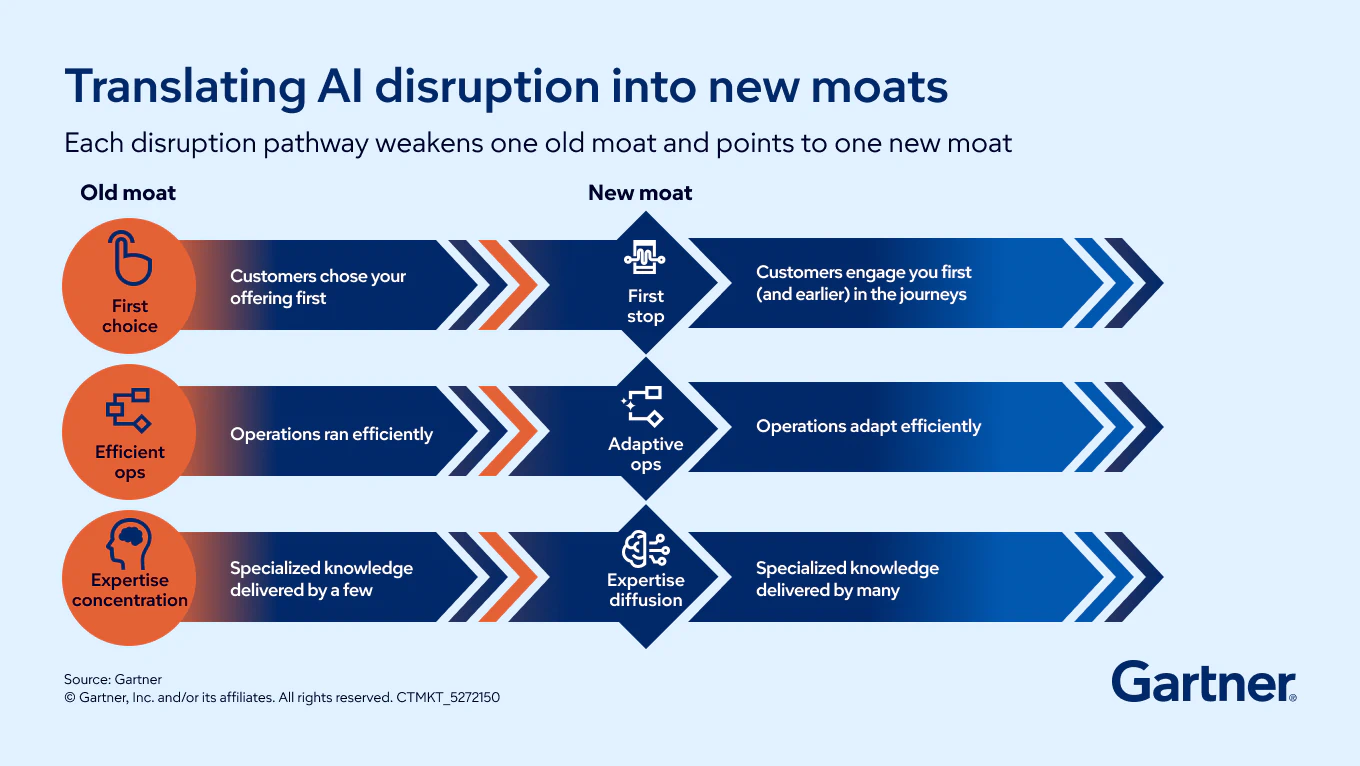
AI is creating shockwaves as it changes how customers interact, how operations are managed and how expertise is delivered. These shifts are eroding the structural advantages, known as business moats, that once protected enterprises from competitors. As AI tools mediate consumer contact, demand more adaptive operations and diffuse expertise across systems, CIOs must act quickly to maintain their competitive edge. “To keep up, executive leaders face a binary choice: Create new moats while defending the old or be left behind,” says Gartner Distinguished Vice President Analyst Brook Selassie.
The failure of three classic moats — first choice, efficient operations and expertise concentration — shows up as underperforming channels, diminishing returns on marketing and volatile service performance. Brands are no longer the consumer’s first choice. Operational excellence is easier to copy and expertise is becoming widely accessible through AI-enabled systems.
How CIOs can build a stronger competitive moat for AI
CIOs are uniquely positioned to respond as they sit at the intersection of technology, enterprise architecture and operational reality. Boards increasingly rely on CIOs to translate AI risk, opportunity and feasibility into concrete action. CIOs must raise the right questions, challenge complacency and convene business and technology leaders to confront moat erosion with a coherent, AI-literate response.
Temporal disruption is shifting customer loyalty
AI assistants, search layers and comparison engines are helping customers make decisions before they reach brands or suppliers. Insurance companies see their old moats carved from brand equity and agent networks eroding as AI comparison engines commoditize underwriting, intensifying competition as these companies compare options by pricing for consumers within minutes. To compete, insurance companies have to create a new moat to replace their eroding advantages. One possible solution is to build proprietary AI assistants that leverage unique data and intelligence, turning AI from enemy to ally as it carves a new moat.
Operational disruption is making efficiency easier to copy
AI enables frequent replanning across networks, plants and inventories, making static operating models obsolete. Leading shipping companies are integrating AI to recalibrate routing, delivery and labor allocation throughout the day. Some industrial automation providers are using AI-supported maintenance and production planning to detect anomalies earlier, anticipate downstream effects and replan in near real time. The advantage now lies in operations that learn and adjust continuously, not just those that run lean processes.
Competence disruption is diffusing expertise across systems
AI is embedding analyst judgment into software and workflows, allowing competitors to replicate expertise once reserved for a narrow group of specialists.
AI-driven recommendation engines and guided workflows help distribute expertise across frontline teams, while AI-enabled tools provide direct, real-time guidance to employees. As a result, competitive advantage increasingly depends on how effectively an organization codifies, operationalizes and applies expertise at scale through technology, rather than just the size of its analyst workforce.
Five actions CIOs must take to rebuild and defend their competitive moat
AI shockwaves don’t wait for annual planning cycles and don’t erode moats evenly. CIOs should manage AI and moat strategies as one agenda. Identify receding moats, track value migration and direct capital, architecture and governance to new sources of control. Gartner recommends five key actions:
- Identify moat vulnerabilities: Guide business units to assess which AI disruptions pose the greatest threat.
- Map value migrations: Track shifts in customer initiation and operational constraints.
- Adopt a two-horizon strategy: Bolster existing moats while building new ones by embedding AI.
- Align resources: Prioritize investments that enhance demand capture, adaptive execution and embedded judgment.
Establish leadership accountability: Assign clear ownership for defending current moats and developing new ones.
AI competitive moat FAQs
What is a competitive moat and why is it important for CIOs?
A competitive moat is a structural advantage that protects a business from competitors, but AI is eroding these moats. Responding to moat erosion is a team sport, but it falls first to CIOs because they sit at the intersection of technology change, enterprise architecture and operational reality.
How can CIOs defend their competitive moat?
CIOs should identify which moats are receding, track where value is migrating and direct capital, architecture and governance toward new sources of control before competitors harden their position.
What are the main disruptions causing competitive moat erosion?
Temporal, operational and competence disruptions are weakening traditional moats. CIOs must recognize which disruption is most critical and act to build new moats aligned with AI-driven value migration.
Attend a Conference
Experience Information Technology conferences
With exclusive insights from Gartner analysts on the latest trends, sessions curated for your role and unmatched peer networking, Gartner conferences help you accelerate your priorities.
7 – 9 Dec 2026
Gartner Identity & Access Management Summit
Las Vegas, NV

Drive stronger performance on your mission-critical priorities.