AI-powered ERP is transforming traditional systems of record into engines of real-time intelligence, automation and action.
- Gartner client? Log in for personalized search results.
![[ALT TEXT]](https://emt.gartnerweb.com/ngw/globalassets/en/information-technology/infographics/hype-cycle-for-erp-2026.webp)
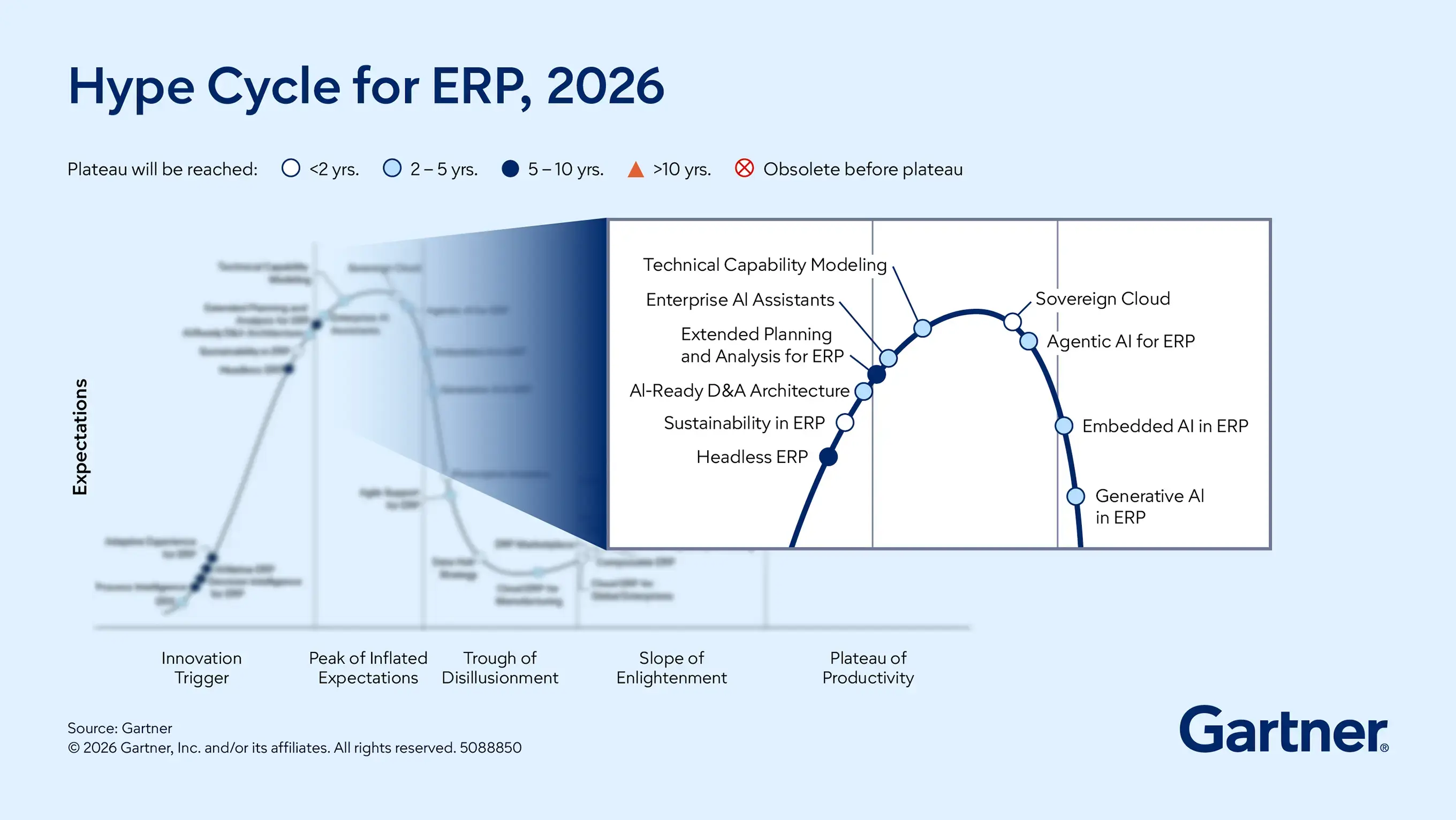
How AI is transforming ERP strategy for enterprise leaders
Organizations are facing increasing volatility, and AI is emerging as a keystone for delivering greater insight, connectivity and productivity across the enterprise. Many organizations mistakenly view AI as just another technology to adopt; in reality, it’s a catalyst reshaping the very nature of enterprise resource planning (ERP).
As organizations embrace AI, they aim to amplify knowledge and insights, connect disparate systems, enhance productivity and efficiency, and automate business processes. This Gartner Hype Cycle™ report provides critical insights to help leaders cut through the noise and implement impactful AI innovations alongside foundational enterprise application technologies.
Key innovation themes in the 2026 Gartner Hype Cycle for ERP
This year’s Hype Cycle for ERP synthesizes insights from 2,000 technologies and applied frameworks that Gartner profiles annually, offering a comprehensive view of the innovations most likely to enhance and evolve ERP. Three core themes emerge, spanning both foundational technologies and AI.
Extended insights are driving smarter decision-making
Advanced data management, analytics and modeling are increasingly emphasized to drive better business insights and strategic planning via embedded intelligence.
Extended insights augment and automate decision making, replacing the analytical and discovery work that typically takes place in separate applications. This theme spans a range of decision-making requirements, defined by both the depth of insights needed and the level of decision autonomy.
Connected data underpins flexible ERP architectures
Modular, flexible, cloud-based ERP architectures built on connected data represent a mature, integrated approach to managing and exploiting data across the enterprise. By leveraging metadata, continuous analytics and robust integration technologies, organizations can create a cohesive data ecosystem that enables autonomous orchestration, embedded insights and adaptive user experiences.
Connected data is complemented by fluid knowledge and information management, especially for unstructured data and content that move seamlessly between enterprise applications and people. AI agents and assistants curate this information to be accurate, relevant and trusted, ensuring it can be reliably consumed and acted upon across the organization.
AI and autonomous ERP accelerate transformation
The integration of artificial intelligence and automation technologies represents the third core theme. This underpins the future of ERP and acts as a catalyst for developing the disciplines required to navigate an AI-powered ERP environment.
These three themes do not operate in isolation; they converge in a concept called enterprise resource execution (ERX). The shift toward AI-driven, autonomous ERP is embodied in ERX, which combines the reliability of traditional ERP systems of record with a robust layer of intelligence that extends across enterprise boundaries. This approach creates a composable, event-driven architecture in which human and machine intelligence work together to optimize outcomes and productivity, not just track them. Gartner predicts that half of these innovations will reach mainstream adoption within the next two to five years.
The result is a shift from static, inward-facing systems to adaptive platforms that sense, decide and act in real time, transforming the enterprise from a system of record into a system of continuous execution and intelligence.
Gartner Hype Cycle for ERP FAQs
What are the main innovation themes in the Gartner Hype Cycle for ERP?
The main themes are AI-driven autonomous ERP, advanced data management, analytics and modeling, and connected data and ERX. These focus on embedding intelligence, integrating data and leveraging AI to transform ERP into adaptive, real-time platforms.
How should organizations prioritize Gartner Hype Cycle for ERP innovations?
Organizations should prioritize innovations that deliver transformational or high impact and are expected to mature within the next two to five years. Timing is key and emerging technologies should be piloted carefully, while mature innovations can be more broadly adopted.
What is ERX in the context of the Gartner Hype Cycle for ERP?
ERX combines traditional ERP reliability with intelligence that extends across the enterprise. It enables adaptive, event-driven architectures where human and machine intelligence collaborate, turning ERP into a system of continuous execution and intelligence.
Attend a Conference
Experience CIO and IT Executive conferences
With exclusive insights from Gartner analysts on the latest trends, sessions curated for your role and unmatched peer networking, Gartner conferences help you accelerate your priorities.
22 – 23 Feb 2027
Gartner CIO Leadership Forum
Phoenix, AZ

Drive stronger performance on your mission-critical priorities.