AI value increasingly depends on knowing what systems do, what they cost and how to govern them.
- Gartner client? Log in for personalized search results.
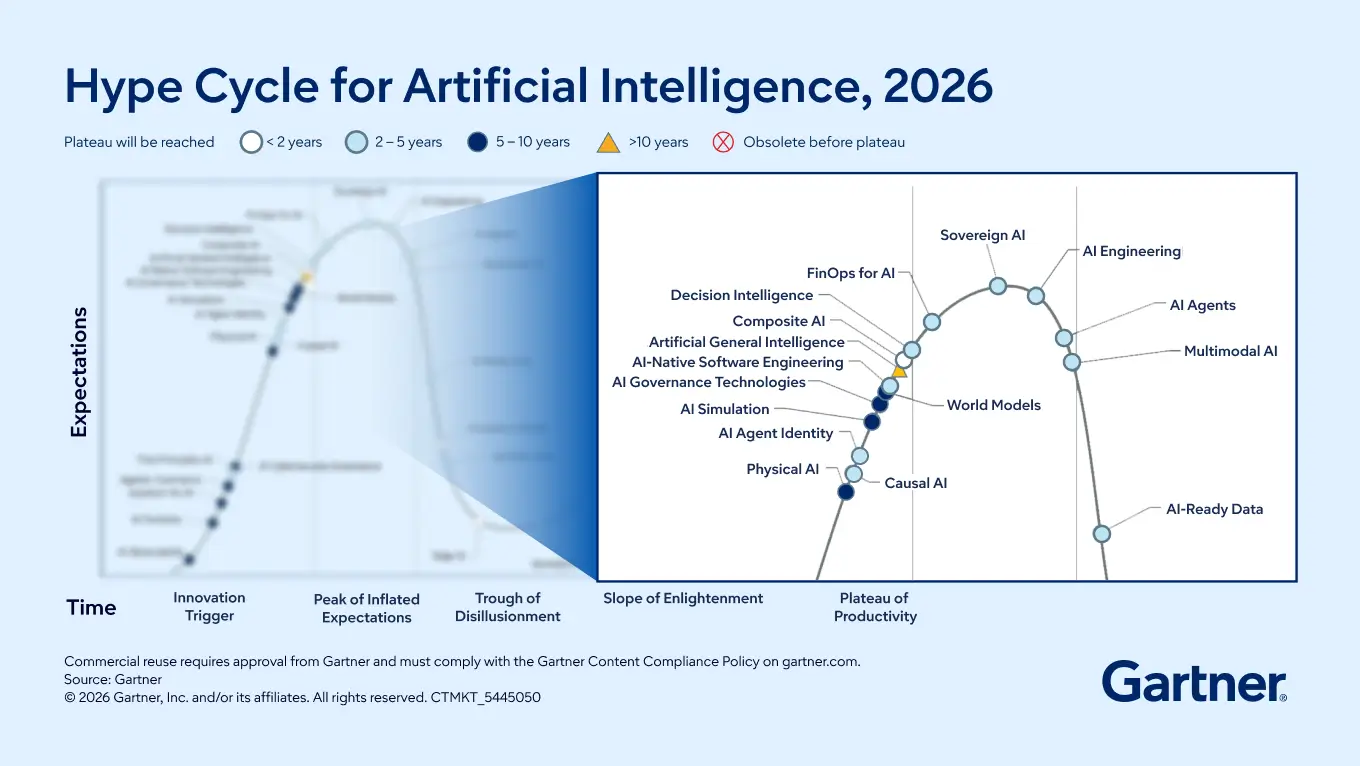
The AI challenge has shifted from building to accountability
AI investment remains strong, but value realization remains uneven. According to Gartner, the defining question of 2026 has shifted from whether an enterprise can build with AI to whether it can account for what its AI is doing and what it costs. “These questions underpin almost everything on this year’s Hype Cycle, including the technologies that have matured, those accelerating faster than expected and those that are new to or repositioned on the cycle,” says Haritha Khandabattu, Vice President Analyst at Gartner.
This shift reflects a broader reality across the AI landscape. Concerns about GenAI have shifted from model capability to application reliability and return on investment.
At the same time, organizations are accelerating adoption of AI agents, physical AI and agentic commerce, creating new governance, security and cost management challenges.
You might also like this webinar: How to Scale AI Agents Without Losing Control
AI control layers have become a leadership priority
As AI expands into more business processes, Gartner finds that organizations must prioritize the systems that make AI accountable, governable and financially sustainable.
Governance must scale alongside AI adoption
The gap between AI ambition and AI execution is widening. Gartner finds that only 17% of organizations have deployed AI agents today, while more than 60% expect to do so within two years. Yet Gartner also expects more than 40% of agentic AI projects to be cancelled by the end of 2027 because of cost, unclear value or inadequate risk controls.
This trend highlights a growing business challenge. Organizations are deploying increasingly capable AI systems before establishing the controls needed to manage them safely and effectively. As a result, Gartner identifies governance and identity infrastructure as prerequisite investments for scaling agentic, physical and commerce-facing AI. Rather than treating governance as a later-stage activity, leaders should view it as foundational to sustainable AI adoption.
Visibility is becoming as important as performance
Organizations cannot manage what they cannot see. That is why Gartner identifies AI observability as one of the most consequential developments on the 2026 Hype Cycle.
AI observability acts as a telemetry layer that detects silent failures and plausible but incorrect outputs that traditional monitoring tools were not designed to assess. Gartner notes that the market remains immature and fragmented, with many providers covering only a single layer of the AI stack.
AI governance technologies build on those signals by providing policy enforcement capabilities. Together, these technologies help ensure that executive intent aligns with operational safeguards. As AI systems become more autonomous and more deeply embedded in enterprise operations, organizations need stronger visibility into system behavior before they can confidently scale adoption.
Cost accountability is emerging as a competitive requirement
The rapid adoption of frontier AI models, AI agents and physical AI is increasing pressure on compute resources. Leaders must shift from retrospective expense monitoring to active compute-cost prevention for humans and agents.
Gartner recommends a three-pronged approach that includes enforcing intelligence tiering, implementing dynamic session budgets with circuit breakers and deploying cross-vendor automated cost controls and remediation capabilities. This challenge is particularly important because current AI FinOps capabilities remain immature. Organizations will need to rely on incomplete solutions until the market matures.
The implication for leaders is clear: AI value will depend not only on deploying advanced capabilities but also on controlling risk, visibility and cost. Organizations that strengthen these control layers early will be better positioned to realize AI value as adoption accelerates.
Artificial intelligence FAQs
What does Gartner identify as the biggest artificial intelligence shift in 2026?
Gartner identifies a shift from building AI systems to accounting for what those systems do and what they cost. Questions of reliability, governance, observability and ROI validation now play a larger role in AI success than basic model availability.
Why is artificial intelligence governance becoming more important?
According to Gartner, organizations are adopting AI agents, physical AI and agentic commerce faster than they are developing controls for identity, security and risk management. Governance technologies help align executive intent with system safeguards and support responsible scaling.
How can organizations improve artificial intelligence value realization?
Gartner recommends prioritizing governance and security infrastructure, improving AI observability and shifting from expense monitoring to active compute-cost prevention. These capabilities help organizations manage risk, control costs and improve accountability as AI adoption grows.
Attend a Conference
Experience Information Technology conferences
With exclusive insights from Gartner analysts on the latest trends, sessions curated for your role and unmatched peer networking, Gartner conferences help you accelerate your priorities.
19 – 22 Oct 2026
Gartner IT Symposium/Xpo™
Orlando, FL

Drive stronger performance on your mission-critical priorities.