Failing to manage the buildup of AI debt could lead to stalled projects and wasted investments.
- Gartner client? Log in for personalized search results.
Adopt a strategic approach to managing AI debt
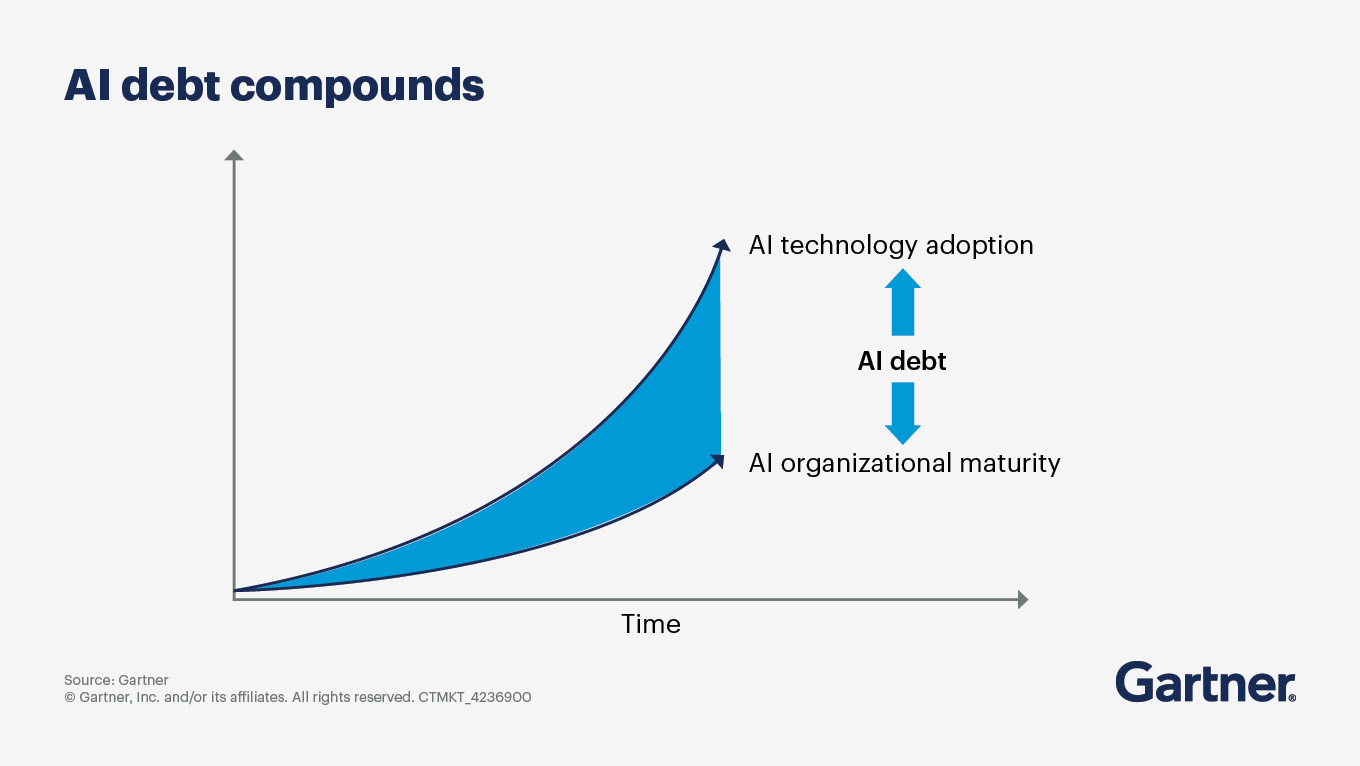
AI initiatives that prioritize short-term gain over long-term sustainability often lead to the accumulation of AI debt. Without proactive management, AI debt can compound rapidly, and left unaddressed, it will significantly impact an organization’s ability to pivot, scale and innovate.
However, AI debt can (and should) be used strategically. Organizations that take a dedicated approach to managing AI debt will realize greater business value and mature up to 500% faster over the next three years.
See Gartner insights in action at our CIO conferences and events.
Don’t fear AI debt
AI debt may be unavoidable, but smart organizations recognize that strategically managing this debt is key to better business value and innovation.
What is AI debt?
Gartner defines AI debt as the accumulated cost of past decisions — intentional or not — that favor short-term gains in AI-related work over long-term sustainability, resulting in future burdens like rework, inefficiencies, risks and missed opportunities. Every organization accumulates AI debt as it scales, regardless of industry, company size or maturity levels.
Successful organizations are not only aware of their AI debt, they actively manage it and embrace these key principles:
AI debt is inevitable: If an organization is deploying AI, it will have technical, organizational and cultural debt, because AI systems evolve faster than the structures supporting them. The existence of AI debt is not a failure, it is a natural byproduct of progress.
AI debt increases with each cycle of innovation: As organizations adopt new models, platforms and use cases, they often prioritize speed and experimentation over integration, governance and sustainability. Each innovation cycle introduces new dependencies, architectural complexity and organizational strain.
AI debt will compound left unaddressed: Without active management, each cycle of innovation will compound AI debt leading to rework, delays, degraded performance and mounting oversight burdens.AI debt is interconnected: AI debt rarely exists in isolation. Deficiencies in one area often ripple across the organization, requiring a systems-level response.
Consider the AI trade-offs
A key piece of AI debt accumulation is the “trade” — how one thing is exchanged for another, creating debt. For example, trading AI infrastructure sustainability for speed in real-time fraud detection or sacrificing long-term wins in new markets for short-term gains in existing ones.
Organizations need to consider why they incur AI debt, how much they can afford, when (or if) it can ever be repaid and the impact those answers will have on the organization. Accumulation of AI debt leads to constraints of liquidity which, in turn, limits the ability to pivot, scale or reinvest.
However, smart organizations who actively manage AI debt to reset the relationship between debt entities, freeing up liquidity and enabling the organization to adapt, optimize value delivery and avoid reinforcing systemic constraints with localized fixes.
How to address AI debt strategically
As AI debt is a systemic issue, it must be addressed across the entire organization. Successful management requires a deliberate, multipronged approach, guided by six principles:
Design for sustainable debt, not zero debt: Not all AI debt is harmful. The goal is to ensure debt exists in the right places and at the right levels. Strategic debt pockets, when aligned with the organization’s AI debt appetite, can unlock liquidity and support continuous reinvestment in high-value areas.
Educate senior decision makers: Building senior literacy enables AI debt to be treated as a strategic lever, not just a technical clean up. Executive briefings, scenario modeling and maturity frameworks can highlight the risks of unmanaged AI debt, while informing executives about the potential for strategic trade-offs.
Embed debt-handling practices into the AI life cycle: Build debt management into processes from design to deployment, ensuring every new use case considers existing debt.
Link debt management to value delivery: Tie debt repayment to business outcomes. For example, addressing technical debt in an AI recommendation engine’s data workflows improve time to value for AI-driven customer retention.
Justify and prioritize debt: Not all debt is equal. Focus on high-impact debt that unlocks reuse, portability and platform flexibility. Prioritize common solutions that benefit the broader organization.Integrate debt modeling into portfolio governance: Without portfolio oversight, AI debt will compound, which means AI portfolio managers must understand how to identify where debt accumulates and where it can be repaid.
Recommended resources for Gartner clients*:
Key Design Principles to Combat AI Debt
*Note that some documents may not be available to all Gartner clients.
AI Debt FAQs
What is AI debt?
AI debt is the accumulated cost of past decisions — intentional or not — that prioritize short-term gains in AI-related work over long-term sustainability. This leads to future burdens such as rework, inefficiencies, risks and missed opportunities.
How does AI debt accumulate?
AI debt builds up as organizations make decisions that favor immediate results over sustainable growth in their AI initiatives. It spans seven dimensions of AI maturity: strategy, value, organization, people and culture, governance, engineering and data. AI debt is multidimensional and self-reinforcing, compounding as organizations scale AI and adopt new technologies.
Attend a Conference
Experience Information Technology conferences
With exclusive insights from Gartner analysts on the latest trends, sessions curated for your role and unmatched peer networking, Gartner conferences help you accelerate your priorities.
19 – 22 Oct 2026
Gartner IT Symposium/Xpo™
Orlando, FL

Drive stronger performance on your mission-critical priorities.